Ebook (EPUB)£90.00
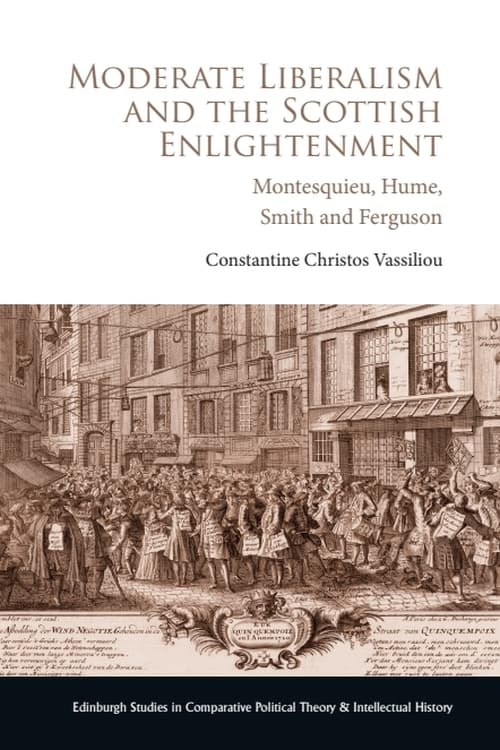
PoliticsEdinburgh Studies in Comparative Political Theory and Intellectual History
Moderate Liberalism and the Scottish Enlightenment
Montesquieu, Hume, Smith and Ferguson

Our ebooks are read in the Academic Reader app. After you buy, we’ll email you how to open your ebook in it.
Description
Examines how Montesquieu, Hume, Smith and Ferguson's foundational liberal theories responded to the moral and civic challenges of early capitalism
- Brings together discussions of key Enlightenment thinkers Montesquieu, David Hume, Adam Smith and Adam Ferguson
- Recaptures a conceptual space in the famous eighteenth-century commerce and virtue debates, which illustrates the possibility that one may accept the general principles of modernity while maintaining a healthy skepticism towards commerce
- Compares how Montesquieu and key thinkers of the Scottish Enlightenment developed their distinct theories of honour in the context of eighteenth-century high finance, namely, in response to the infamous collapse of the Mississippi and South Sea ‘bubbles’ (1720)
- Provides a heuristic for identifying when commercial innovation poses a threat to liberal societies, and a framework for balancing commercial ends with the public good under conditions of liberal democracy
- Expands the currency of ideas available in foundational liberal thought for identifying an emotional quality that is necessary for twentyfirst-century citizenship
Montesquieu's Moderate Liberalism and the Scottish Enlightenment responds to a perennial problem in political theory: how to balance commercial considerations with the public good. It investigates this dilemma through the lenses of Enlightenment thinkers whose liberal theories responded to the hazards of commercial innovation during capitalism’s nascent stages. Vassiliou argues that Montesquieu, David Hume, Adam Smith and Adam Ferguson represent a moderate perspective in foundational liberal thought, which emphasizes the critical importance of honour. He compares how their liberal theories uniquely channel human beings’ desire for honour to nourish a sense of interpersonal magnanimity within an inward-looking, liberal commercial world. In an age of polarized extremes, we have witnessed restive democracies flirting with populist, illiberal responses for managing the hazards of capitalist innovation. Montesquieu and his Scottish counterparts’ foundational liberal theories offer us more viable, middle-ground prescriptions which are sensitive to the emotional constitution of a liberal society.
Contents
Acknowledgements
Preface
A Liberal Framework for Inspiring Magnanimity in the Modern Commercial WorldIntroduction
Montesquieu’s Moderate Liberalism and the Scottish EnlightenmentChapter 1.
From High Society to High Finance: ‘John Law’s System and the Spectre of Modern Despotism'Chapter 2.
‘Real Wealth’ vs. ‘Fictional Wealth’ in an Age of High Finance: Montesquieu, Hume and SmithChapter 3. ‘
Ancient Prudence' Vs. ‘Modern Prudence': Montesquieu’s Response to James HarringtonChapter 4.
Montesquieu and Hume’s English and French AffinitiesChapter 5.
Liberty and Honour in Britain and FranceChapter 6.
Montesquieu’s HonourChapter 7.
A Liberal Art for the Commercial World: Adam Smith and Adam FergusonConclusion
Moderate Liberalism for a Commercial World in TransitionBibliography
Author
Reviews
Constantine Vassiliou’s ambitious book offers its readers a timely opportunity to reexamine Montesquieu’s complex ideas on finance, commerce, honor, and liberty in the context of his engagement with the ideas of the Scottish Enlightenment. It starts from the impact of the events related to John Law’s system on Montesquieu’s intellectual formation and puts his ideas in dialogue with Adam Smith, David Hume, and Adam Ferguson. Vassiliou admirably succeeds in shedding fresh light on the complexity of Montesquieu’s liberalism and invites us to rethink the importance of political moderation for addressing our contemporary economic and political challenges.
Moderate Liberalism and the Scottish Enlightenment is an effectively ambitious book. On the one hand, it weaves together, in intriguing ways, thoughts gathered from Montesquieu and the central figures of the Scottish Enlightenment; on the other hand, it slyly juxtaposes those thoughts with recent concerns about the practical and theoretical status of liberalism and its critics. This is a needed study for the times in which we live.
Original, engaging, and very insightful. Moderate Liberalism and the Scottish Enlightenment offers a rare combination of historical context and philosophical probity necessary for a serious study of political philosophy.
This thoughtful and readable book offers a sequence of comparative analyses of the political thought of Montesquieu and his major Scottish interlocutors: David Hume, Adam Smith, and Adam Ferguson [...] Each chapter rests on a thorough command of the relevant primary material and offers conceptually illuminating scholarship.
Goes well with this book
From the same series or subject.
- Moderate Liberalism and the Scottish Enlightenment, Ebook (EPUB), £24.99
- Herodotus and the Birth of Freedom, Ebook (EPUB), £90.00
- Machiavelli and the Religion of the Ancients, Ebook (EPUB), £95.00
From the same series
More in Edinburgh Studies in Comparative Political Theory and Intellectual History
Ebook (EPUB)£95.00
Ebook (EPUB)£90.00
Ebook (EPUB)£24.99
Ebook (EPUB)£24.99
Ebook (EPUB)£24.99
Ebook (EPUB)£25.99
Ebook (EPUB)£20.99
Ebook (EPUB)£25.99
Ebook (EPUB)£20.99
Ebook (EPUB)£26.99
More in Politics
View all
Ebook (EPUB)£25.00
Ebook (EPUB)£25.00

Ebook (EPUB)£16.99

Ebook (EPUB)£24.99