Paperback£24.99
PoliticsIntelligence, Surveillance and Secret Warfare
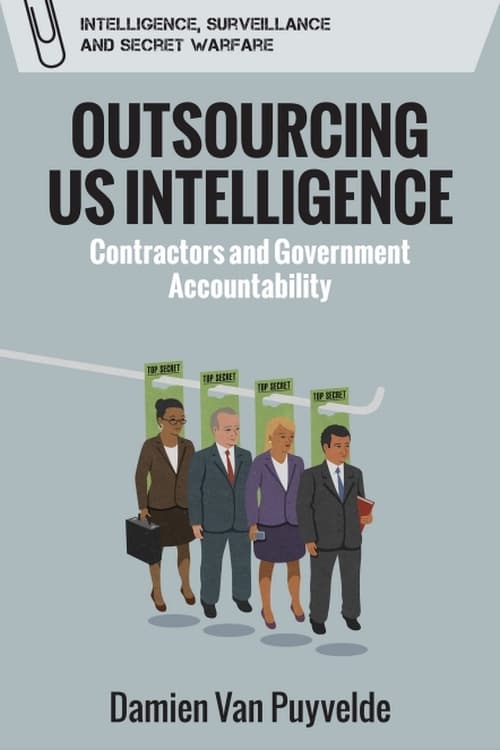
Outsourcing US Intelligence
Contractors and Government Accountability

Our ebooks are read in the Academic Reader app. After you buy, we’ll email you how to open your ebook in it.
Description
Explores the evolving role of contractors in the US Intelligence Community, particularly after the Cold War
- Draws on declassified documents and exclusive interviews with key stakeholders
- Develops a new conceptual framework to analyse intelligence accountability issues
- Provides a balanced analysis of intelligence outsourcing based on empirical evidence In the 21st century, more than any other time, US agencies have relied on contractors to conduct core intelligence functions. This book charts the swell of intelligence outsourcing in the context of American political culture and considers what this means for the relationship between the state, its national security apparatus and accountability within a liberal democracy. Through analysis of a series of case studies, recently declassified documents and exclusive interviews with national security experts in the public and private sectors, the book provides an in-depth and illuminating appraisal of the evolving accountability regime for intelligence contractors.Case Studies
- The Air Force, the CIA and the U-2 spy plane
- CIA and In-Q-Tel
- FBI and Virtual Case File
- NSA and Trailblazer
- Contractors in the interrogation room
- Contractors crossing the line
Contents
Acknowledgments; List of Abbreviations; Figures; Introduction; 1. Broadening Intelligence Accountability; 2. A Shared History of Successes and Excesses; 3. The Growth of Intelligence Contracting in the Post-Cold War Era; 4. The Accountability Regime for Contractors during the Global War on Terrorism; 5. Improving Government Oversight of Intelligence Contractors; 6. The Future of Intelligence Outsourcing; Conclusion; Bibliography; Index.
Author
Reviews
The book’s strengths are in its willingness to sort through the utter minutiae of both existing and failed legislation. For this, Van Puyvelde should be lauded for doing truly onerous labor. Van Puyvelde painstakingly demonstrates that Congress is not only sensitive to concerns about intelligence outsourcing, but that there are numerous examples of legislation, passed and failed, that reveal a continual evolution of the relationship between contractors and the government. Van Puyvelde makes clear that while the relationship is not perfect, it is far from out of the norm and is increasingly regulated in the state’s interests.[...] Ultimately what Van Puyvelde manages to do is to write broadly into an academic lacuna that links intelligence outsourcing with accountability. Van Puyvelde’s book works most effectively as a primer for graduate students seeking an introduction to intelligence and a nuanced counterargument against bombastic claims about intelligence out of control through the private marketplace.
The book’s strengths are in its willingness to sort through the utter minutiae of both existing and failed legislation. For this, Van Puyvelde should be lauded for doing truly onerous labor. Van Puyvelde painstakingly demonstrates that Congress is not only sensitive to concerns about intelligence outsourcing, but that there are numerous examples of legislation, passed and failed, that reveal a continual evolution of the relationship between contractors and the government. Van Puyvelde makes clear that while the relationship is not perfect, it is far from out of the norm and is increasingly regulated in the state’s interests.[...] Ultimately what Van Puyvelde manages to do is to write broadly into an academic lacuna that links intelligence outsourcing with accountability. Van Puyvelde’s book works most effectively as a primer for graduate students seeking an introduction to intelligence and a nuanced counterargument against bombastic claims about intelligence out of control through the private marketplace.
The role of outside contractors in government intelligence activities has been controversial. In the face of impediments to research, this book provides a wealth of insight into the challenges of accountability when democracies outsource their intelligence responsibilities.
This is an important and timely book because it broadens Intelligence Studies’ traditional concentration on state intelligence agencies and their oversight (or lack thereof) by examining the position of private contractors in US intelligence governance. There was little concern until post-9/11 scandals erupted around the abuse of detainees at Abu Ghraib in Iraq and raised the question of whether government officials can uphold the public interest in national security when intelligence is outsourced. Conceptually, the author draws on the principal-agent model to develop his analytical framework of the accountability process. [...] This is an important book establishing the groundwork for future research and scholarship in this critical public-private area of Intelligence Studies.
Privatization can be for the public good, even in the realm of national security. That is the hypothesis that this accomplished and profoundly significant volume sets out to test, and the author’s insights are crystal clear.
Goes well with this book
From the same series or subject.
- Outsourcing US Intelligence, Ebook (EPUB), £23.99
- Iraqi Ba‘thists in America’s Cold War, Paperback, £24.99

- Intelligence, Security and the State, Ebook (EPUB), £95.00

From the same series
More in Intelligence, Surveillance and Secret Warfare
Ebook (EPUB)£95.00

Ebook (EPUB)£24.99
Ebook (EPUB)£24.99

Ebook (EPUB)£24.99

Ebook (EPUB)£25.99

Ebook (EPUB)£31.00

Ebook (EPUB)£27.99
Ebook (EPUB)£22.99

Ebook (EPUB)£33.99

Ebook (EPUB)£29.99

Ebook (EPUB)£23.99
More in Politics
View all
Ebook (EPUB)£25.00

Ebook (EPUB)£25.00


Ebook (EPUB)£16.99

Ebook (EPUB)£24.99