Ebook (EPUB)£95.00
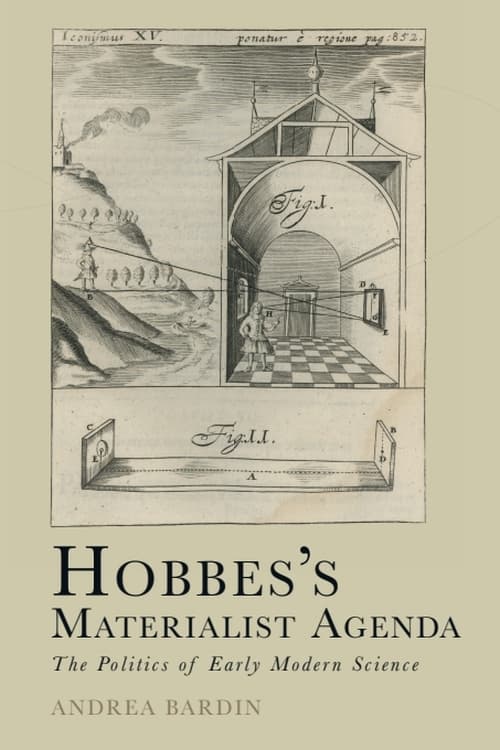
Hobbes’s Materialist Agenda
The Politics of Early Modern Science

Our ebooks are read in the Academic Reader app. After you buy, we’ll email you how to open your ebook in it.
Description
In this major contribution to our understanding of Hobbes’s political thought, Andrea Bardin contends that it should be analysed in relation to the ‘materialist agenda’ Hobbes was pursuing when confronting Descartes’s project. Bardin pinpoints the changes in Hobbes’s political thought to the intellectual context in which he elaborated his materialist ontology and epistemology. He investigates the classical sources that initially shaped Hobbes’s political thinking, including Thucydides and Aristotle, as well as the broad materialist agenda that Hobbes drew from Bacon and elaborated in opposition to Descartes. He studies Hobbes’s exchanges with his contemporary interlocutors in the Mersenne circle, including Descartes and Gassendi, with whom he discussed first philosophy and natural philosophy. In this way, Bardin vindicates materialist critiques of the idealist foundations of early modern mechanical philosophy.
Contents
Acknowledgments
List of Abbreviations
Introduction: Hobbes’s Materialist Agenda
PART I
Chapter 1 – Ontology and Epistemology in Hobbes’s mechanics
1.1 The Quaestio de certitudine mathematicarum and the Pseudo-Aristotelian Mechanica
1.2 Bacon’s materialist project and Galileo’s mathematical revolution
1.3 The Mersenne circle and Gassendi
1.4 Descartes’s dualist foundation of mechanics
1.5 Hobbes’s Materialist Geometry and the System of the Sciences
Chapter 2 – Political Epistemology: the strange case of Hobbes’s scientia civilis
2.1 The table of sciences in Leviathan IX: what’s the problem with civil philosophy?
2.2 Civil science as political techne
2.3 The twofold method of civil science
2.4 On the neutrality and purpose of civil science
Chapter 3 – Political Ontology: the body politic as an artificial automaton
3.1 The passive matter of mechanics
3.2 The political anthropology of mechanics
3.3 The automation of wisdom
3.4 The political automaton imagined
PART II
Chapter 4 – From The Elements of Law to De cive: the powerless power of civil science
4.1 The Elements of Law: an ‘optical’ ontology
4.2 De cive: a ‘geometrical’ epistemology
4.3 On the laws of (human) nature
4.4 The powerless superiority of recta ratio
4.5 Empowering right reason: Hobbes’s modest Platonism
Chapter 5 – The political stakes of determinism: ‘liberty’, ‘conatus’, ‘void’, ‘causa integra’
5.1 On liberty
5.2 On conatus
5.3 On void
5.4 On causa integra
5.5 The political stakes of determinism
Chapter 6 – Leviathan Becoming Behemoth: Back to Ideology
6.1 Neutralising human power (potentia/potestas)
6.2 The civil person and the materiality of representation
6.3 Imagination: a material principium for the body politic
6.4 From Leviathan to Behemoth: for a theory of ideology
6.5 The political myth of mechanical philosophy
Bibliography
Author
Reviews
This is a meticulously researched and carefully wrought study of the epistemological and ontological quandaries Hobbes navigated while engaging challenges posed by Bacon, Galileo, and Descartes. Bardin gives a fascinating analysis of the compromises Hobbes makes vis à vis his materialist metaphysics for the sake of securing political stability.
The history of philosophy is conducted in many ways, some painstaking but short on engagement with big issues, while other approaches take a broader perspective, but miss out on the detail of historical scholarship. The best histories combine the two, merging scholarly detail with theoretical daring. This work is exemplary in combining meticulous scholarship with incisive political and philosophical judgment on what was important about theoretical responses to the new mechanical sciences. Andrea Bardin is an exciting scholar, who knows Hobbes well, and he is fully versed in debates on materialism and idealism. He sees Hobbes as a materialist, whose materialism and political theory were undermined by the temptations of a foundational reading of the new mechanism. This book will prove vital in our readings of Hobbes and materialism.
Bardin lays bare the reasons for Hobbes’s failure and demonstrates the ideological consequences of an ahistorical materialism, ultimately interrogating the political category of “materialism” itself in order to render it effective once again.
Goes well with this book
From the same series or subject.
- Hobbes’s Materialist Agenda, Ebook (EPUB), £90.00
- Hobbes's Body Politics, Ebook (EPUB), £95.00
- The Idea of the Instant in Descartes's Philosophy, Ebook (PDF), £90.00
From the same series
More in Cycles
Ebook (PDF)£90.00
Paperback£24.99
Paperback£19.99

Ebook (EPUB)£19.99
Ebook (EPUB)£24.99
Ebook (EPUB)£19.99
Ebook (EPUB)£20.99
Ebook (EPUB)£27.99
Ebook (EPUB)£95.00
More in Philosophy
View all
Ebook (EPUB)£95.00

Ebook (EPUB)£110.00

Ebook (EPUB)£150.00

Ebook (EPUB)£24.99
Ebook (EPUB)£90.00