Ebook (EPUB)£95.00
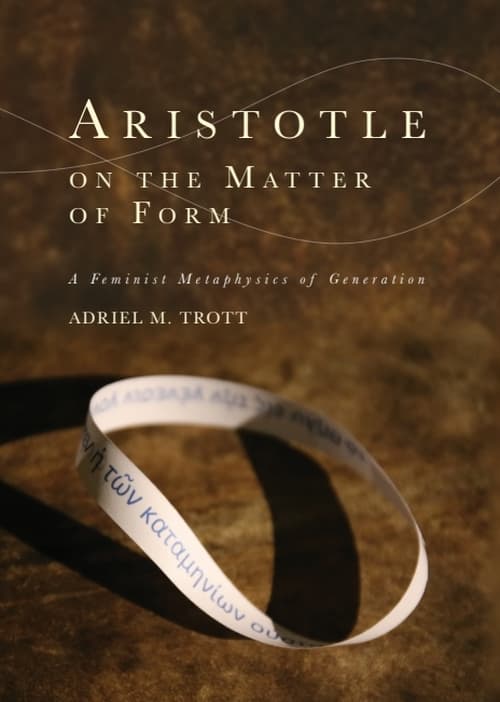
Aristotle on the Matter of Form
Α Feminist Metaphysics of Generation

Our ebooks are read in the Academic Reader app. After you buy, we’ll email you how to open your ebook in it.
Description
Argues for an interdependent relationship of form and matter in Aristotle's metaphysics
- Offers a clear and innovative account of Aristotle's biological works, informed by Continental philosophy and inflected by feminist interests and concerns
- Contextualises Aristotle's views of gender in ancient Greek mythology, medicine and early philosophy
- Situates its argument in the debates between Luce Irigaray and Judith Butler on the meaning and role of matter in the history of philosophy
- Challenges the gender binary by challenging the metaphysical binary of form and matter: an association that can be traced to Aristotle
- Showcases how Aristotle's account is fundamentally phenomenological
Adriel M. Trott challenges the wholesale acceptance of the view that nature operates in Aristotle's work on a craft model, which implies that matter has no power of its own. Instead, she argues for a robust sense of matter in Aristotle in response to feminist critiques. She finds resources for thinking the female's contribution – and the female – on its own terms and not as the contrary to form, or the male.
Using the image of a Möbius strip, Trott considers how semen and menses flow through Aristotle's account of generation. She weaves together scholarship on matter, form and generation in Aristotle; on the mythological, Hippocratic and Pre-Socratic treatments of the feminine and the elemental; and on feminist readings of material. In doing so, she demonstrates the interdependence of form and matter in Aristotle's biology.
Contents
Introduction MethodHistorical ApproachesOne-Sex and Two-Sex ModelsThe Problem of Aristotle and the One- and Two-Sex ModelsMaterial Evidence
1. Feminist Critics of Aristotle’s Biology and Metaphysics
The Feminist DisputesFeminist Critics Who Say Aristotle’s Biology is SexistCritics Who Say Aristotle’s Biology is Not SexistFeminist Critics and Defenders of Aristotle’s Metaphysics Conclusion2. Disputes Over the Material Contribution of Semen
Robust Material View versus Restricted Material ViewMaterial Necessity and TeleologyAristotle and Plato on FormConclusion3. Aristotle on Material
Beyond Prime MatterPhysics I 7: Change and the SubstratumMetaphysics VII 3: Substance as SubstratumDe Caelo IV 5: The Elements in CommonHow Matter is ManyOn Generation and CorruptionMatter in Natural Substances: Generation as a ProblemSoul as the Actuality of the Body: The User and the ImplementThe Ways of Being Acted Upon: Like and Unlike4. The Feminine and the Elemental in Greek Myth, Medicine and Early Philosophy
Gender, Generation and the GodsThe Elemental Among the Pre-SocraticsHippocratics, Elemental Powers and GenderConclusion5. Semen, Menses, Blood: Material in Generation
Concoction as Mastery of the MoistureInternalised Heat: From Blood to SemenMaterial and Teleology in Aristotle’s MeteorologyHow Semen is a Causal PartMaterial Composition of SemenSources of Vital Heat: Stomach, Sun and Earth6. Sex Differentiation, Inheritance and the Meaning of Form in Generation ‘The Female is, As it Were, Deformed.’How Sex Differentiation Explains the Work of Form and MatterHow Inherited Traits Explain the Role of FormContradiction and Contrariety
7. Craft and Other Metaphors Craft Analogy Explains Why Generation Needs Males and Why it Happens in FemalesCraft Analogy Explains How Semen Actualises FormOther Images and Metaphors
Conclusion: On Material in Aristotle’s Biology ConclusionRevisiting the One-Sex and Two-Sex ModelsThe Möbius Strip
Bibliography; Index Locurum; Index
Author
Reviews
Adriel M. Trott’s book skillfully and exhaustively places Aristotle’s theory of animal generation and his account of inherited characteristics in its literary and philosophical context to develop an enmattered account of form and an active account of matter that challenges the artifactual interpretation of hylomorphism and, with it, the grounds for many feminist criticisms of Aristotle’s metaphysics as gendered and sexist
Adriel M. Trott develops a careful, thorough and provocative re-reading of Aristotle that acknowledges his complex legacy for contemporary feminist philosophy. Trott convincingly shows how his conception of form and matter is bound up with and remains surreptitiously connected to the binarization of male and female, even as it remains misunderstood.
Goes well with this book
From the same series or subject.
- Aristotle on the Matter of Form, Ebook (EPUB), £27.99
- Hobbes's Body Politics, Ebook (EPUB), £95.00
- The Idea of the Instant in Descartes's Philosophy, Ebook (PDF), £90.00
From the same series
More in Cycles
Ebook (PDF)£90.00
Ebook (EPUB)£90.00
Paperback£24.99
Paperback£19.99
Ebook (EPUB)£19.99
Ebook (EPUB)£24.99
Ebook (EPUB)£19.99
Ebook (EPUB)£20.99
Ebook (EPUB)£95.00
More in Philosophy
View all
Ebook (EPUB)£95.00
Ebook (EPUB)£110.00
Ebook (EPUB)£150.00

Ebook (EPUB)£24.99
Ebook (EPUB)£90.00