Ebook (EPUB)£95.00
PhilosophyNew Perspectives in Ontology
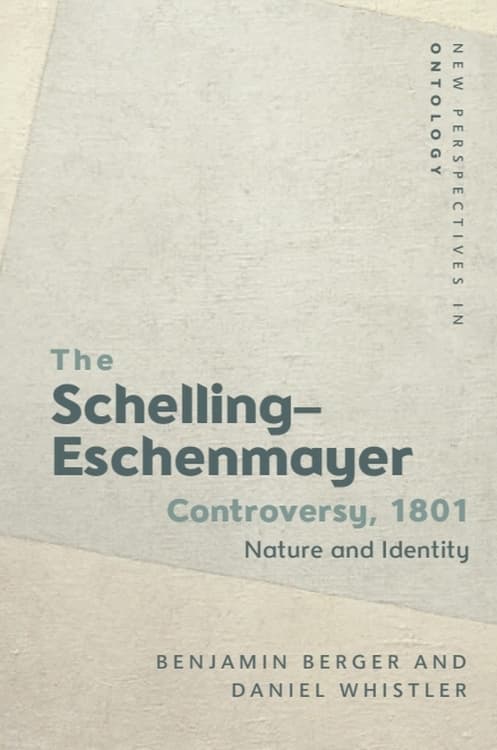
The Schelling-Eschenmayer Controversy, 1801
Nature and Identity

Our ebooks are read in the Academic Reader app. After you buy, we’ll email you how to open your ebook in it.
Description
A study of the genesis of Schelling’s philosophy of nature and absolute idealism, highlighting the importance of A. K. A. Eschenmayer
- The first extended English-language treatment of Eschenmayer’s philosophy, particularly his influential innovations in the philosophy of nature and his doctrine of the potencies
- Includes explanatory notes and a substantial historical Introduction that situates them in context
- Translations include Eschenmayer’s Propositions on the Metaphysics of Nature, his Highest Principle of Philosophy of Nature and Schelling’s On the True Concept of Philosophy of Nature, plus correspondence between Eschenmayer and Schelling from 1799 to 1801
- Comments in detail on key concepts in Schelling’s philosophy and German Idealism more broadly, such as identity, drive, potency, the quantity/quality relation and abstraction
- Considers the transition from Schelling’s early philosophy of nature to his philosophy of identity
During the first decade of the 19th century, F. W. J. Schelling was involved in 3 distinct controversies with one of his most perceptive and provocative critics, A. K. A. Eschenmayer. The first of these controversies took place in 1801 and focused on the philosophy of nature. Now, Berger and Whistler provide a ground-breaking account of this moment in the history of philosophy. They argue that key Schellingian concepts, such as identity, potency and abstraction, were first forged in his early debate with Eschenmayer. Through a series of translations and commentaries, they show that the 1801 controversy is an essential resource for understanding Schelling’s thought, the philosophy of nature and the origins of absolute idealism.
Additionally, Berger and Whistler demonstrate how the Schelling–Eschenmayer controversy raises important issues for the philosophy of nature today, including questions about the relation between identity and difference and the possibility of explaining sensible qualities in terms of quantity. This ultimately leads to the formulation of the most basic methodological question for the philosophy of nature: must this philosophy be based upon a prior consideration of consciousness – as Eschenmayer insists – or might it simply begin with nature itself? By arguing for the latter position, Schelling challenges us to entertain the possibility that the philosophy of nature is first philosophy.
Contents
Preface; Abbreviations
Translators’ Note
Introduction: Schelling and Eschenmayer in 1801
Part I: Texts
A. K. A. Eschenmayer, Spontaneity = World Soul, or the Highest Principle of Philosophy of Nature
F.W.J. Schelling, On the True Concept of Philosophy of Nature and the Correct Way of Solving its Problems
Part II: Commentaries
1. Quality
2. Potency
3. Identity
4. Drive
5. Abstraction
Part III: Appendices
1. A. K. A. Eschenmayer and F.W.J. Schelling, Correspondence, 1799-1801
2. A. K. A. Eschenmayer, Principles of Nature-Metaphysics Applied to Chemical and Medical Subjects [Extracts]
3. A. K. A. Eschenmayer, Deduction of the Living Organism [Extracts]
4. A. K. A. Eschenmayer, Review of Schelling’s First Outline and Introduction to the Outline
Authors
Reviews
This excellent book focuses on a decisive moment in Schelling’s philosophical development [...] Berger and Whistler show how much the two philosophers learn from each other despite their fundamental disagreements, and one senses their friendship and mutual respect. This volume makes a significant contribution to our understanding of the development of German Idealism—but it also provides a model for dialogue and philosophical collaboration.
An outstanding contribution to our understanding of Naturphilosophie, often thoughtlessly derided, that preoccupied Schelling and contemporary interlocutors such as Eschenmayer. Brilliant commentaries on the key texts here translated illuminate long obscured detail vital to a philosophical address to nature, creating an exemplary volume, unparalleled in any language.
Goes well with this book
From the same series or subject.
- The Schelling-Eschenmayer Controversy, 1801, Ebook (EPUB), £22.99
- Schelling and The Ages of the World, Ebook (EPUB), £95.00
- Absolute Dialetheism, Ebook (EPUB), £105.00
From the same series
More in New Perspectives in Ontology
Ebook (EPUB)£105.00
Ebook (EPUB)£90.00

Ebook (EPUB)£19.99
Ebook (EPUB)£24.99

Ebook (EPUB)£19.99
Ebook (EPUB)£19.99

Ebook (EPUB)£22.99

Ebook (EPUB)£20.99
Ebook (EPUB)£22.99
Ebook (EPUB)£27.99
Ebook (EPUB)£22.99
More in Philosophy
View all
Ebook (EPUB)£95.00

Ebook (EPUB)£110.00
Ebook (EPUB)£95.00

Ebook (EPUB)£150.00

Ebook (EPUB)£24.99