Ebook (EPUB)£24.99
LawEdinburgh Critical Studies in Law, Literature and the Humanities
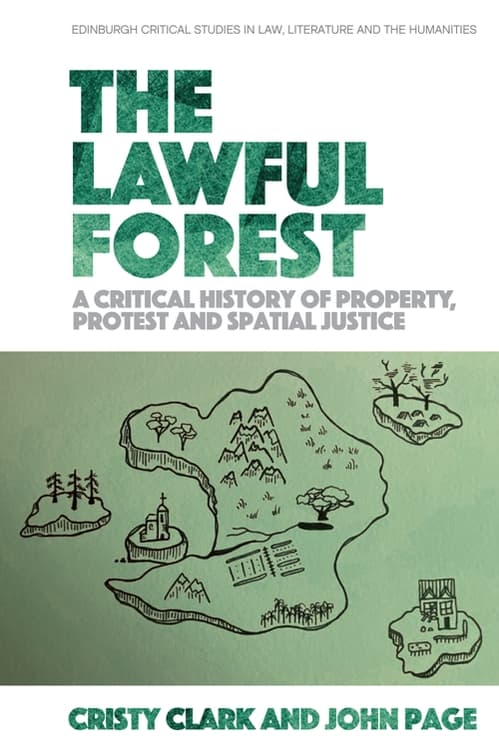
The Lawful Forest
A Critical History of Property, Protest and Spatial Justice

Our ebooks are read in the Academic Reader app. After you buy, we’ll email you how to open your ebook in it.
Description
Views the ‘lawful forest’ as both a material forest of trees, and a metaphor for a more relational understanding of law, property and place
- Undertakes a wide-ranging exploration of our diverse relationships with land that brings together critical property theory and legal geography
- Explores spatial justice, Indigenous perspectives, and the intersecting discourses of property and human rights
- Draws on the literature of critical common law property, legal geography, the radical commons, legal custom, protest and the forest
- Includes line drawings at the beginning of each chapter that evoke the imagery of the forest to create thematic links between each section
This book is a study of the critical history of space, and the ways in which a dominant property ideology has entrenched an exclusionary and profoundly alienating version of spatial ordering. It focuses on select periods in time, when the seemingly linear trajectory of enclosure momentarily wavers and alternate spatial paths briefly materialise, before ‘disappearing’ from plain sight. Using the forest as a thematic device, Cristy Clark and John Page explore the tensions that pervade our propertied relationships: between commodity and community, abstraction and context, and private enclosure and the public square.
The book draws on a range of case studies including the 13th century Forest Charter, Thomas More’s Utopia, the Diggers’ radical agrarianism, the Paris Commune’s battle for the right to the city, and Australian forest protestors of the late 20th and early 21st centuries. By analysing these movements and their contexts, Clark and Page illustrate the origin, history and legal status of the lawful forest and its modern-day companions. Although the dominant spatial paradigm is one where private rights prevail, this book shows that communal relationships with land have always been part of our law and culture.
Contents
Introduction
- A Theory of the Forest
- The Ancient Forest
- A Glimpsed Utopia
- A Concrete Utopia
- Ecological Communes
- A Future Dystopia
Index
Authors
Reviews
The Lawful Forest is an important contribution to legal history, one that may alter perceptions of the natured history of law for those of conventional property scholarship as well as those more akin to critical property studies, decolonial and post-Marxist scholarship. The work is important for anyone working on understanding the history of the common law and its connection with property forms, where lost accounts of the shaping of black-letter law can be just as useful for a property law professor as for their students.The connecting of custom, nature and community in this text, offers an invaluable archive of all those past and future, in the task of a ‘figurative yearning for a spatial life lived better’ (39).
The Lawful Forest is an important contribution to legal history, one that may alter perceptions of the natured history of law for those of conventional property scholarship as well as those more akin to critical property studies, decolonial and post-Marxist scholarship. The work is important for anyone working on understanding the history of the common law and its connection with property forms, where lost accounts of the shaping of black-letter law can be just as useful for a property law professor as for their students.The connecting of custom, nature and community in this text, offers an invaluable archive of all those past and future, in the task of a ‘figurative yearning for a spatial life lived better’ (39).
This highly original and thought-provoking book takes a scholarly and eclectic approach to thinking about property. Its shift in analytical lenses reveals debates about resources and assets, combining theoretical and pragmatic insights to raise distinctive research questions.
Goes well with this book
From the same series or subject.
- The Lawful Forest, Ebook (EPUB), £25.99
- The Rise and Fall of Critical Legal Studies, Ebook (EPUB), £24.99
- The Faustian Pact in International Law, Ebook (EPUB), £24.99
From the same series
More in Edinburgh Critical Studies in Law, Literature and the Humanities
Ebook (EPUB)£24.99
Ebook (EPUB)£25.99
Ebook (EPUB)£26.99
Ebook (EPUB)£26.99
Ebook (EPUB)£19.99
Ebook (EPUB)£22.99

Ebook (EPUB)£22.99
Ebook (EPUB)£22.99
Ebook (EPUB)£27.99
Ebook (EPUB)£22.99
Ebook (EPUB)£29.99