Ebook (EPUB)£24.99
LawEdinburgh Critical Studies in Law, Literature and the Humanities
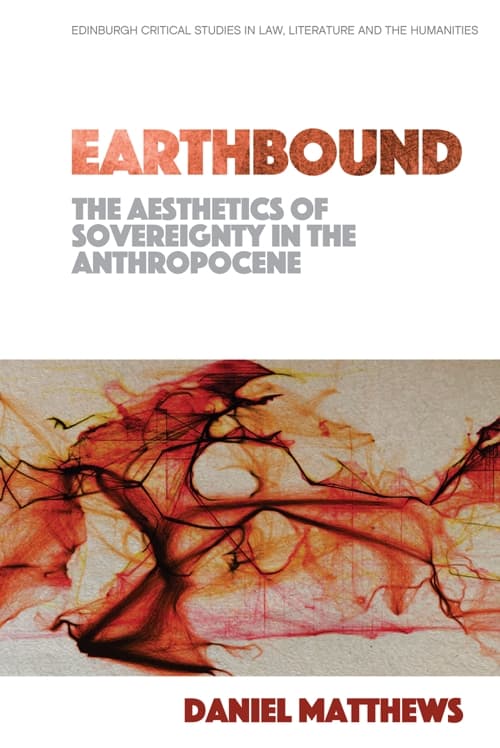
Earthbound: The Aesthetics of Sovereignty in the Anthropocene

Our ebooks are read in the Academic Reader app. After you buy, we’ll email you how to open your ebook in it.
Description
Winner of the Penny Pether Prize 2021Examines how sovereignty inures us from the challenges associated with the climate crisis
- Engages with the work of Bruno Latour, Simone Weil, Clive Hamilton, Jacques Rancière, Donna Haraway, Judith Butler, Giorgio Agamben, Stuart Elden and others
- Presents an innovative theory of sovereignty’s ‘aesthetics’ that contributes to contemporary debates in legal and political theory
- Outlines the key challenges for law and politics provoked by the Anthropocene epoch
In this book, Daniel Matthews shows how sovereignty – the organising principle for modern law and politics – depends on a distinctive aesthetics that ensures that we see, feel and order the world in such a way that keeps the realities of climate change and ecological destruction largely ‘off stage’. Through analysis of a range of legal, literary, ecological and philosophical texts, this book outlines the significance of this aesthetic organisation of power and explores how it might be transformed in an effort to attend to the various challenges associated with the Anthropocene, setting the grounds for a new, ecologically attuned, critical jurisprudence.
The Anthropocene thesis contends that human impact on the environment has become so extreme that the earth system as a whole has been tipped into a new state. This new geological epoch demands sensitivity to the forces that traverse human and nonhuman life, the geological, ecological and atmospheric.
Contents
Introduction; 1. Earthbound in the Anthropocene; 2. The Aesthetics of Sovereignty; 3. Territory; 4. People; 5. Scale; Afterword; Bibliography.
Author
Reviews
Daniel Matthews’s Earthbound makes a convincing case for why the response to climate change is not a serious challenge but the serious challenge for our time. He shows us that the comfortable division between the social and the natural has been erased and so the very boundaries and scope of human agency must be re-evaluated and reconsidered. Given that the great conceit of Western forms of sovereignty is that it controls and determines everything within its boundaries, we see that the advent of the Anthropocene gives a new and terrifying power to sovereign authority. In grappling with this challenge, Matthews does not suggest jettisoning sovereignty as such, especially as there are many forms of sovereignty, including indigenous ones that inherently recognize the fact of human existence within the context of—rather than above—nature. Instead, he looks at the aesthetics of sovereignty, how it shapes us even as we use it to shape the world around us, in order to rethink and redeploy key concepts of the Western and globally dominant mode of sovereignty, specifically in terms of territory, people and scale. This unique way of understanding sovereignty allows Matthews to add some teeth to the idea of rethinking the way we live in the world. Whereas such calls can be, and usually are merely gestural, by drilling down into the sediment of how sovereignty is lived and experienced, rather than just wielded, Matthews shows a path to action instead of just more talk. For this reason alone his work is both timely and critically vital.
Goes well with this book
From the same series or subject.
- Earthbound: The Aesthetics of Sovereignty in the Anthropocene, Ebook (EPUB), £19.99
- The Rise and Fall of Critical Legal Studies, Ebook (EPUB), £24.99
- The Faustian Pact in International Law, Ebook (EPUB), £24.99

From the same series
More in Edinburgh Critical Studies in Law, Literature and the Humanities
Ebook (EPUB)£24.99

Ebook (EPUB)£25.99
Ebook (EPUB)£25.99

Ebook (EPUB)£26.99
Ebook (EPUB)£26.99

Ebook (EPUB)£22.99

Ebook (EPUB)£22.99

Ebook (EPUB)£22.99
Ebook (EPUB)£27.99
Ebook (EPUB)£22.99
Ebook (EPUB)£29.99