Ebook (EPUB)£150.00
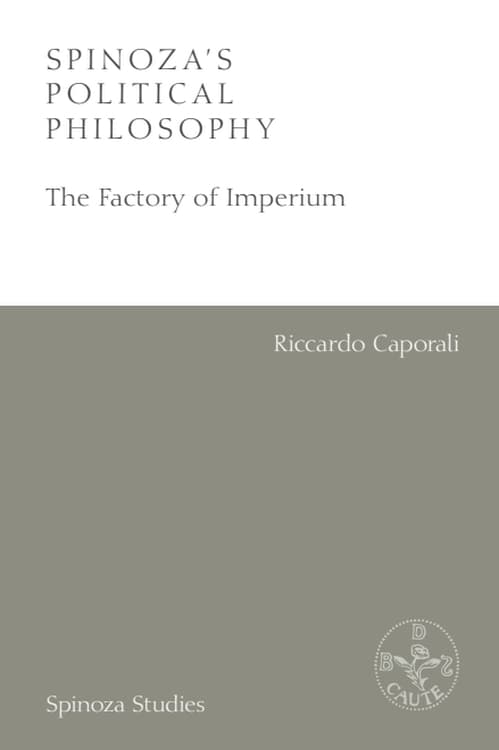
Spinoza's Political Philosophy
The Factory of Imperium

Our ebooks are read in the Academic Reader app. After you buy, we’ll email you how to open your ebook in it.
Description
Examines the close and circular connection between metaphysics, ethics and politics in Spinoza's thought
- Shows the entire system of Spinoza’s philosophy to revolve around an ethical–political challenge, dictated by historical circumstances
- Offers a different perspective from recent philosophical-political interpretations of Spinoza
- Provides the first systematic study of the metaphysic roots behind Spinoza’s strongest political statements
- Weaves in comparisons and references to Machiavelli, Descartes, Hobbes, Locke, Vico and Hegel, and to many contemporary interpretations of Spinoza’s thought
Riccardo Caporali examines of all of Spinoza’s works while addressing the challenges imposed by the historical circumstances at the time. As a result, Spinoza’s work and its author – the philosopher and the man – go hand in hand.
Focusing on Spinoza’s constant preoccupation with the relationship between metaphysics and politics, Caporali shows that it takes different forms in his various major works. He highlights specific moments of this discontinuity, particularly in the transition between the Tractatus Theologico-Politicus and the Tractatus Politicus.
Contents
Introduction: ‘I am a good Republican’
1. Metaphysics and PoliticsNon nimis improprie (Descartes)‘Therefore it will be the cause of itself’ (Spinoza)Causa rerumEo sensu
2. Towards a Political Order
The imagination of order (premise)The conatusNothing is more useful to manNatural LawThe artifice of nature3. A Militant Design: The Theological-Political Treatise
Philosophy and theologyObedienceUniversal faithThe free RepublicThe pactum4. Between Realism and Project: The Political Treatise
RealismMultitudoThe Kinds of StateOn MonarchyThe AristocracyAbsolutum, sive democratiaThe patience of the excludedBibliography
A. Works by SpinozaB. Other AbbreviationsC. Secondary LiteratureIndex
Authors
Reviews
Developing an interpretation of Baruch Spinoza’s political thought, Caporali surveys the Theological-Political Treatise and the unfinished Political Treatise, but roots his analysis in the metaphysics of Spinoza’s masterwork, the Ethics. Caporali begins with the concept of causa sui (cause of itself), which frames God’s causal power not as will or authority but as the generative unity of substance. Summing Up: Recommended. Graduate students, researchers, faculty.
[...] its panoramic quality, strengths in close reading, fluency in the history of ideas and elegant style will interest scholars working across early modern political thought. [...] translations like this are making accessible a world of continental studies in Spinoza that should greatly enrich forward-looking research.
Through an accurate analysis of Spinoza’s work, from Part I of Ethics to the last line of the Political Treatise, Caporali displays the political thought of the author in all its depth and novelty. Rarely, if ever, has such a controversial topic been presented with this much clarity and coherence.
Goes well with this book
From the same series or subject.
- Spinoza's Political Philosophy, Ebook (EPUB), £20.99
- Spinoza's Critique of Hobbes, Ebook (EPUB), £150.00
- Spinoza and the Sign, Ebook (EPUB), £120.00

From the same series
More in Spinoza Studies
Ebook (EPUB)£120.00
Ebook (EPUB)£115.00
Ebook (EPUB)£90.00
Ebook (EPUB)£24.99
Ebook (EPUB)£29.99
Ebook (EPUB)£24.99

Ebook (EPUB)£29.99
Ebook (EPUB)£24.99
Ebook (EPUB)£19.99
Ebook (EPUB)£24.99

Ebook (EPUB)£19.99
More in Philosophy
View all
Ebook (EPUB)£95.00
Ebook (EPUB)£110.00
Ebook (EPUB)£95.00

Ebook (EPUB)£24.99
Ebook (EPUB)£90.00