Ebook (EPUB)£22.99
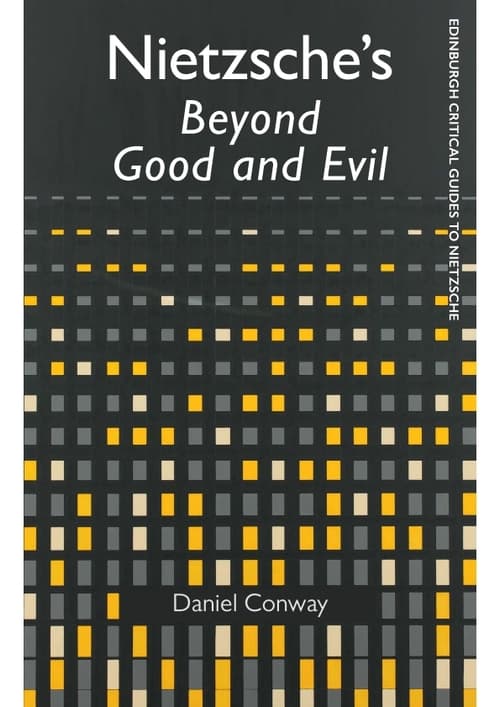
PhilosophyEdinburgh Critical Guides to Nietzsche
Nietzsche's Beyond Good and Evil

Our ebooks are read in the Academic Reader app. After you buy, we’ll email you how to open your ebook in it.
Description
Guides you through one of the most clearly developed statements of Nietzsche’s mature philosophy, section by section
- Pays sustained attention to the philosophical arguments and rhetorical strategies that inform Beyond Good and Evil and advance its main narrative
- Carefully analyses the influential concepts and hypotheses, for example: will to power, the death of God, master-morality vs slave-morality, the order of rank, the noble soul and the return of Dionysus
- Profiles the ‘philosophers of the future’, whom Nietzsche envisions as ‘commanders and legislators’
- Dedicates a chapter to each section, each including a preview, a summary of sections and a review
- Helpful student features include chronology, a glossary of key terms and a guide to further reading
Adopting an interpretative approach throughout, Daniel Conway treats Beyond Good and Evil as a coherent, unified and carefully crafted complete text. When treated this way, the text reveals itself as a guide to the education that Nietzsche prescribes for his best readers, at the brink of the new, post-moral era. Conway makes sense of the overarching aims and structure of the book at the same time as providing a broader context for the arguments Nietzsche makes and the positions he stakes out. Requiring no prior knowledge of the text or of Nietzsche, he guides you through the text with the reward of a more developed reading of the distinctly political agenda that emerges in the second half of Beyond Good and Evil.
Contents
Chronology
IntroductionThe Title and Subtitle of BGENietzsche’s Aims in BGENietzsche’s Target Readership
- Nietzsche’s Preface
- Part One: On the Prejudices of PhilosophersPreviewSummary of SectionsThe Will to TruthThe Will to Truth and the Prejudices of PhilosophersUntruth as a Condition of LifeIntroducing the Will to PowerPsychology: The Once and Future Queen of the SciencesReview
- Part Two: The Free SpiritPreviewSummary of SectionsThe Self-Overcoming of MoralityReintroducing the Will to PowerTurning to the FutureReview
- Part Three: The Religious CharacterPreviewSummary of SectionsDissolving the Paradox of the SaintThe Religious InstinctThe Misanthropic Atheism of Modern PhilosophyThe 'New' PhilosophersThe Calamity of European ChristianityReview
- Part Four: Epigrams and InterludesPreviewSummary of SectionsNietzsche’s InfluencesRecurring Themes and Persistent MotifsReview
- Part Five: On the Natural History of MoralityPreviewSummary of SectionsThe Imperative of NatureThe Moral NeurosisThe "New" Philosophers: Commanders and LegislatorsReview
- Part Six: We ScholarsPreviewSummary of SectionsPhilosophers as LegislatorsScholarly VirtuesWhat A Philosopher Is (and Does)Review
- Part Seven: Our VirtuesPreviewSummary of SectionsRevisiting the VirtuesThe Many Colors of VirtueThe Many Costumes of Virtue'We Immoralists!'A New TaskReview
- Part Eight: Peoples and FatherlandsPreviewSummary of SectionsThe German SoulCreating a Home for European JewryHow Europe May Become OneReview
- Part Nine: What is Noble?PreviewSummary of SectionsExploiting a "Turning Point in History"Nobility and Self-respectDionysus RevealedReview
- From Lofty Mountains: AftersongPreviewSummary of Stanzas 1–13Summary of Stanzas 14–15Review
Glossary of Key TermsGuide to Further Reading on Beyond Good and EvilBibliographyIndex
Author
Reviews
Daniel Conway’s Nietzsche’s Beyond Good and Evil is an extremely helpful, admirably erudite and deeply persuasive commentary on Nietzsche’s book. He takes more seriously than anyone known to me Nietzsche’s professed intention to help his readers become the kind of readers that his Thus Spoke Zarathustra needed but lacked, and thereby to prepare them to live some day in the distant future in a world beyond the polarity of good and evil. He thus introduces the topic of what it is for a philosophy to change a life, and he follows that theme brilliantly throughout his book.
Daniel Conway’s study of Beyond Good and Evil is a notable example of how contemporary academic commentators can address a specialized, academic audience while also reaching out to the 'free spirits' of a much wider, global readership
Goes well with this book
From the same series or subject.
- Nietzsche's Beyond Good and Evil, Ebook (EPUB), £20.99
- Nietzsche's The Case of Wagner and Nietzsche Contra Wagner, Ebook (EPUB), £22.99

- Nietzsche's The Anti-Christ, Ebook (EPUB), £22.99

From the same series
More in Edinburgh Critical Guides to Nietzsche
Ebook (EPUB)£22.99

Ebook (EPUB)£22.99
Ebook (EPUB)£22.99

Ebook (EPUB)£25.99

Ebook (EPUB)£25.99
More in Philosophy
View all
Ebook (EPUB)£95.00
Ebook (EPUB)£110.00
Ebook (EPUB)£95.00

Ebook (EPUB)£150.00

Ebook (EPUB)£24.99