Ebook (EPUB)£95.00
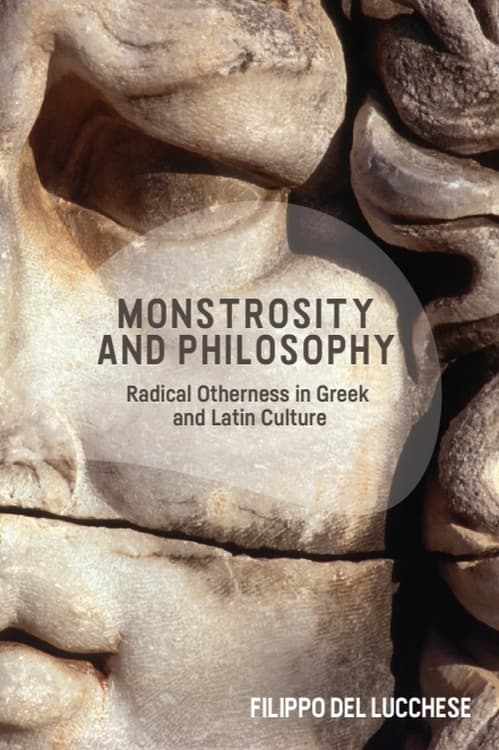
Monstrosity and Philosophy
Radical Otherness in Greek and Latin Culture
Open access
Open access under CC-BY-NC 4.0
Description
Amazons and giants, snakes and gorgons, centaurs and gryphons: monsters abounded in the ancient world. They raise enduring philosophical questions: about chaos and order; about divinity and perversion; about meaning and purpose; about the hierarchy of nature or its absence. Del Lucchese grapples with the concept of monstrosity, showing how ancient philosophers explored metaphysics, ontology, theology and politics to respond to the challenge of radical otherness in nature and in thought.
Contents
Introduction
1. The Myth and the Logos
1.1 Order and Chaos
1.2 Mythical Battlefields: Monstrosity as a Weapon
1.3 Causality and Monstrosity: Challenging Zeus
2. The Pre-Platonic philosophers
2.1 Anaxagoras: A Material Origin for Life and Monstrosity
2.2 Empedocles: Wonders to Behold
2.3 Democritus: Agonism within Matter
3. Plato
4. Aristotle
5. Epicurus and Lucretius
5.1 An Immanent Causality for an Infinite Universe
5.2 Zoogony, Monstrosity, and Nature’s Normativity
5.3 Concourses of Nature
5.4 Lucretius’s Impact on the Augustan Age
6. Stoicism
6.1 Nominalism
6.2 Good and Evil, Beauty and Ugliness
6.3 Providence, God and Teleology
7. Scepticism
7.1 The Tropes and the Critique of Essentialism
7.2 To What Purpose?
8. Middle and Neoplatonism
8.1 The Material World and the Rediscovery of Transcendence
8.2 Demons
8.3 The World Order
Bibliography
Index Locorum
Index Verborum
Index Rerum
Index Nominum
Author
Reviews
A real masterpiece for all those who intend to understand the wide range of philosophical approaches to defining the Monstrous, Otherness and Evil in the classical world. The text is well written and clearly organised to allow readers to follow the exposition of the author. Multidisciplinary scholars can benefit from Monstrosity and Philosophy; literary critics, classicists, philosophers, and scholars in religious studies can appreciate the diversity of the scholarship and the author’s superb grasp of the subject matter.
Filippo Del Lucchese not only offers a thorough historical inquiry into ancient Greek and Roman teratologies, he explores the fascinating hypothesis that theories of monstrosity are a key topic in the basic philosophical debate about Nature, its mechanisms and its norms. This book should appeal to anyone interested in ancient thought and its relations to modern debates about biological norms.
By studying ancient thought through the lens of monstrosity, Filippo Del Lucchese projects a radically new light on a philosophical period we thought we knew. It is not too much to say that Monstrosity and Philosophy offers a whole new history of the long span from mythological materials and ancient tragedy to the birth of Christian thought and does so in a fascinating and scholarly way. Its original perspective will be a milestone in the study of the history of ideas.
Filippo Del Lucchese's study of the history of the concept of monstrosity from its origins in early Greek thought to early Christianity and Neo-Platonism is an enormously valuable work. His book offers a carefully ordered panoramic view of this history based on an always attentive reading of the works of which it is composed. Del Lucchese shows us nothing less than a history of philosophy on the basis of its monsters, those it created as well as those it discovered, the things that regularly escape the government of providence and the supervision of logos or ratio. In doing so, he invites us to read the Pre-Socratics, Plato, Aristotle, the Epicureans, Stoics and Neoplatonists as responses to what most threatens them: the inassimilable and the irreducibly other. Monstrosity and Philosophy: Radical Otherness in Greek and Latin Culture is a work of immense erudition that surprises the reader at every turn with the interpretations it offers and the connections it reveals. It is destined to become a classic.
D.L.’s extensive study of monstrosity in ancient philosophy (and beyond) contains many useful illustrations of its relevance to ancient physics, metaphysics and indeed ethics. Not least among the book’s important contributions is its demonstration that monstrosity must encompass varying definitions, if it is to be the connecting thread between disparate philosophical viewpoints, from materialism to idealism and from theogony to theodicy.
Goes well with this book
From the same series or subject.
More in Philosophy
View allEbook (EPUB)£110.00
Ebook (EPUB)£95.00
Ebook (EPUB)£150.00

Ebook (EPUB)£24.99