Ebook (EPUB)£24.99
Literary StudiesEdinburgh Critical Studies in Modernist Culture
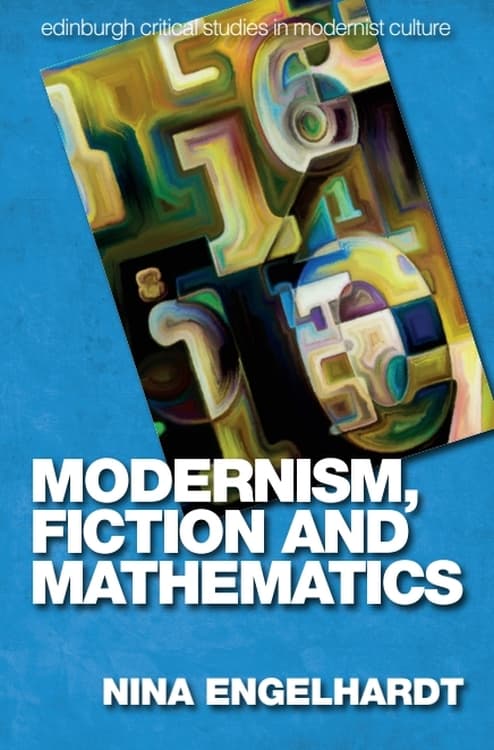
Modernism, Fiction and Mathematics
Open access
Open access under CC-BY-NC 4.0
Description
An analysis of novelistic explorations of modernism in mathematics and its cultural interrelations
Modernism in mathematics – this unusual notion turns out to provide a new perspective on central questions in and beyond literary modernism. Contrasting ‘mathematical fictions’ from and about the heyday of mathematical modernism, this book relates literary engagements with mathematical modernism to the wider context of modernist critiques of Enlightenment values and postmodern reassessments of modernist patterns. The analysis of canonical works by Thomas Pynchon, Hermann Broch, and Robert Musil demonstrates how mathematics is accorded a central role as a particularly telling indicator of modernist transformations, and how imaginative illustrations contribute to establishing mathematics as part of modernist culture. In its interdisciplinary exploration of modernist interrelations between the surprisingly closely related fields of mathematics and literature, the book draws on prose works by mathematicians, research in the history and philosophy of mathematics, and literary scholarship.
Key Features:- Reveals new frames of textual and cultural analysis that help understand the modernist condition from the interdisciplinary perspective of literature and mathematics studies
- Supports the notion of mathematical modernism through analysis of literary fiction, thereby advancing knowledge of modernism in science with a literary perspective
- Highlights the role of mathematics in modernist works and postmodernist re-examinations of modernity and modernism
- Elucidates crucial and not easily accessible aspects of canonical works, which open up new avenues for research
Contents
Acknowledgements
Series Editors’ Preface
Abbreviations
Introduction: All that Counts – Modernism, Fiction, Mathematics
1 Mathematics and Politics: Thomas Pynchon, Against the Day
2 Mathematics, Language, Structure: Hermann Broch, The Sleepwalkers
3 Mathematics, Epistemology, Ethics: Robert Musil, The Man Without Qualities
4 Mathematics and Fiction: Thomas Pynchon, Gravity’s Rainbow
Conclusion: Modernism, Fiction, and Mathematics
Glossary
Bibliography
Index
Author
Reviews
[The book] does not force mathematical concepts on literary works, but analyses texts which are deeply concerned with mathematics and its role in our approach to physical reality, but also as a cultural expression and even moral guideline. It is truly interdisciplinary, i. e. it does not rely on popularizations of science or previous works in the field of ‘science and literature’ but turns to the original source texts and to research from historians of science for the reconstruction of the relevant mathematical concepts and theories.
this is the guidebook to get if you want to make a first step into mathematical territory from that of literature....Engelhardt's mathematical interpretation sheds light on what would remain obscure to most readers by deftly outlining the historical debates that inform the fictional text, but she also interprets these mathematical concerns in fictional terms and thus offers a fresh perspective on the larger modernist crisis of representation....a well-written, thoughtful study whose scope radiates beyond its immediate focus and hopefully will have an impact in more than one scholarly context
Wide-ranging in its interdisciplinary foci and treatment of modernism, Modernism, Fiction, and Mathematics convincingly demonstrates the presence of mathematics in modernist literature and postmodernist reconsiderations of modernism.
Contrasting [Pynchon] to Broch and Musil, comparing modernist to post-modernist writing, makes Engelhardt’s book a gem among the few studies linking mathematics and literature.
Modernism, Fiction and Mathematics, published in the Edinburgh Critical Studies in Modernist Culture series, is a valuable addition to this collection of monographs on modernist art in its intersection with the contextual foundations of material culture, science, philosophy and the like.
Persuasively and engagingly, Nina Engelhardt demonstrates that modernism's relation to contemporary mathematics was often more analogous than adversarial. This fascinating study extends understanding of modernism within its historical and cultural context, opening up a seldom-explored area through incisive critical discussion of mathematics and narrative innovation.
Goes well with this book
From the same series or subject.
From the same series
More in Edinburgh Critical Studies in Modernist Culture
Ebook (EPUB)£19.99
Free to read
Read Modernism and Religion
Ebook (EPUB)£24.99
Ebook (EPUB)£19.99
Ebook (EPUB)£25.99

Free to read
Read Asbestos – The Last Modernist Object
Ebook (EPUB)£25.99
Ebook (EPUB)£22.99
Ebook (EPUB)£22.99

Ebook (EPUB)£22.99
More in Literary Studies
View all
Ebook (EPUB)£125.00

Ebook (EPUB)£110.00
Ebook (EPUB)£90.00
Ebook (EPUB)£90.00

Ebook (EPUB)£90.00