Ebook (EPUB)£90.00
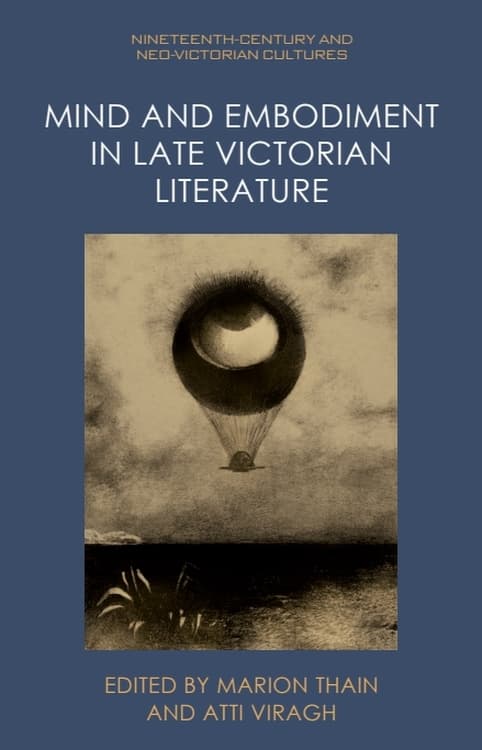
Literary StudiesNineteenth-Century and Neo-Victorian Cultures
Mind and Embodiment in Late Victorian Literature

Our ebooks are read in the Academic Reader app. After you buy, we’ll email you how to open your ebook in it.
Description
Shows how late-Victorian writers develop new understandings of the relationship between cognition and embodiment
- Addresses an interdisciplinary audience interested in literary studies, philosophy of mind, the history of ideas, cognitive psychology, and neurology
- Recovers the participation of British literature in the birth and development of psychology
- Corrects the disciplinary bifurcation between Victorian and modernist discourses about the mind
- Explores problems of aesthetics, narrative, poetics, plastic arts, neurology, physiology, and food metaphors, as well as the legacies of empiricism
The closing decades of the nineteenth century saw the birth of psychology as a discipline. The question of the relationship between mind and body was a central topic of concern across an array of genres, media and textual forms during these years. In this collection we trace the role literature played in responding to fundamental questions within this interdisciplinary intersection. How do writers conceptualize perception, memory, sense-experience, understanding, empathy, cognition, and their relation to embodiment? What is the Victorian contribution to the new conceptions of the nature of thought and feeling developed by such figures as William James in America and Henri Bergson in France? Mind and Embodiment in Late Victorian Literature shows how writers grappled with pivotal intellectual and scientific developments of the nineteenth century—and how these ideas transformed Victorian literature itself.
Contents
Series Preface
Notes on Contributors
Introduction: Mind, Body, Literature, and Psychology in the Later Nineteenth Century
Marion Thain and Atti Viragh
1. Cognitive Eating: George Gissing and the Victorian Brainworker
Colton Valentine
2. Fitzpiers the Empiricist: Malady and Seduction in The Woodlanders
Rachel Kravetz
3. Alice Meynell’s Brain Waves
Gregory Tate
4. Walter Pater’s Embodied Knowledge: In and Out Psychophysiology
Bénédicte Coste
5. Conversion-Crisis as a Marginal Experience in William James and Walter Pater
David Sweeney Coombs
6. Self-Taste, Embodiment, and Language in Gerard Manley Hopkins
Amanda Paxton
7. Neuron Doctrine in Fiction by Marie Corelli and Oscar Wilde
Anne Stiles
8. Vernon Lee: Empathy, Mnemic Engrams, and Satanic Aesthetics
Pamela K. Gilbert
Index
Authors
Reviews
These bold and probing essays brilliantly restore the dynamism and variousness of psychological debate in the final third of the nineteenth century, attuned as it was to the inescapable truth that minds are joined to bodies, while also wary of mechanistic science. What we now call embodied cognition was born in these febrile decades, and its emergence was enabled by writers as familiar as Hopkins, Gissing, Hardy and Vernon Lee but also by figures less visible in literary history such as Alice Meynell. This groundbreaking volume constructs new terms for grasping the invigorating late-Victorian swirl of literature, science and psychology.
Goes well with this book
From the same series or subject.
- Mind and Embodiment in Late Victorian Literature, Ebook (EPUB), £19.99
- Victorian Literature, Queer Longing and the Shore, 1840–1920, Ebook (EPUB), £90.00
- The British Public and the British Museum, Ebook (EPUB), £95.00
From the same series
More in Nineteenth-Century and Neo-Victorian Cultures
Ebook (EPUB)£95.00
Paperback£24.99
Paperback£24.99
Ebook (EPUB)£19.99
Ebook (EPUB)£19.99
Ebook (EPUB)£24.99
Ebook (EPUB)£24.99
Ebook (EPUB)£24.99
Ebook (EPUB)£24.99
Ebook (EPUB)£19.99
Ebook (EPUB)£19.99
More in Literary Studies
View all
Ebook (EPUB)£125.00
Ebook (EPUB)£110.00
Ebook (EPUB)£90.00
Ebook (EPUB)£90.00
Ebook (EPUB)£90.00