£19.99
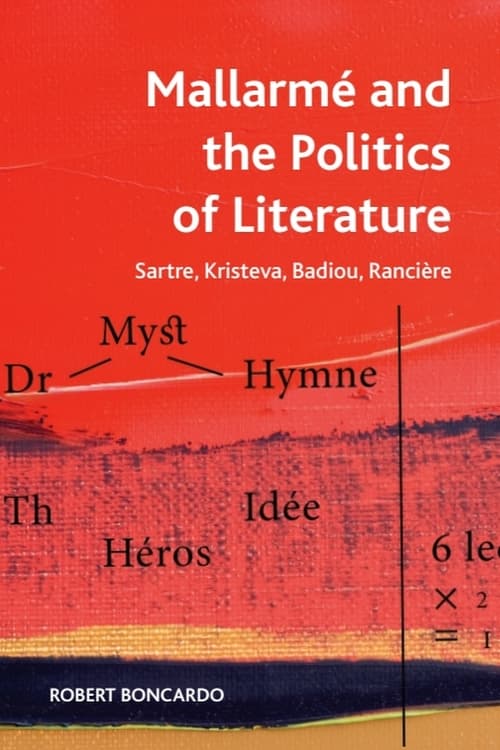
Mallarmé and the Politics of Literature
Sartre, Kristeva, Badiou, Rancière

Our ebooks are read in the Academic Reader app. After you buy, we’ll email you how to open your ebook in it.
Description
Recounts the radical readings of Mallarmé’s seminal poems by some of France’s most important 20th century thinkers
Why is Stéphane Mallarmé, one of modernity’s most ingenious yet obscure poets, so important to French philosophers? With in-depth studies of Jean-Paul Sartre, Julia Kristeva, Alain Badiou and Jacques Rancière, along with shorter analyses of Jean-Claude Milner and Quentin Meillassoux, Boncardo situates Mallarmé within these thinkers' philosophical and political projects.
Key Features- Explains different thinkers' distinct approaches to Mallarmé’s poetry and prose, in particular to their political significance
- Reflects on the various ways literature has been conceived of politically by French thinkers
- The first work of English-language scholarship on each of these thinker’s reading of Mallarmé and the first work to read each of these thinkers in tandem, locating their points of contact and difference
Contents
AcknowledgementsAbbreviationsSeries Editor’s Preface
Introduction: Comrade Mallarmé
- Jean-Paul Sartre’s Mallarmé: Hero of an Ontological Drama, Agent of the Counter-revolution
- Julia Kristeva’s Mallarmé: From Fetishism to the Theatre-Book
- Alain Badiou’s Mallarmé: From the Structural Dialectic to the Poetry of the Event
- Jean-Claude Milner’s Mallarmé: Nothing Has Taken Place
- Jacques Rancière’s Mallarmé: Deferring Equality
Conclusion: From One Siren to Another
Bibliography
Index
Author
Reviews
The name Mallarmé has become a tool for the praise and condemnation of poetry. In French philosophy, he is associated with the intoxicating idea of poetry as politically efficacious, and the counter-charge of effete elitism. In this lively and impressive re-telling, we see how this poet becomes a magnet for a stunning cascade of delirious praise and vilification. Robert Boncardo convincingly shows that despite the insights of the French obsession with Mallarmé, we need new ways to formulate the links between politics and literature.
Robert Boncardo’s study provides a clearly written and helpful guide to writings on Stéphane Mallarmé by several key thinkers of the twentieth century who engaged his thought in their own efforts to reshape the relation of literature to politics. The book delivers more than it promises in the title, since in addition to a chapter on each of the writers mentioned in the subtitle, there is also a short chapter on Jean-Claude Milner, and the conclusion substantially engages the ideas of Quentin Meillassoux … This book will serve as an excellent introduction to the work of all these theorists on Mallarmé, and is of most value in the chapters, such as those on Sartre and Badiou, that clearly trace the evolution and changes in approach over the course of a single thinker’s career and the extent to which there is continuity or rupture in that development. Boncardo offers many important insights both into Mallarmé’s oeuvre and into the ways in which that oeuvre helps these theorists reorient and remap the very definition of what we understand the political to be, in its relationship to modern literature and beyond.
Goes well with this book
From the same series or subject.
- Mallarmé and the Politics of Literature, Ebook (EPUB), £23.99
- Spinoza and Art, Ebook (EPUB), £95.00
- Deleuze and Transcendental Empiricism, Ebook (EPUB), £110.00
From the same series
More in Crosscurrents
£24.99
£24.99
Ebook (EPUB)£19.99
Ebook (EPUB)£19.99
Ebook (EPUB)£26.99
Ebook (EPUB)£22.99
Ebook (EPUB)£27.99

Ebook (EPUB)£22.99
More in Philosophy
View allEbook (EPUB)£95.00
Ebook (EPUB)£110.00
Ebook (EPUB)£95.00
Ebook (EPUB)£150.00
Ebook (EPUB)£24.99