Ebook (EPUB)£95.00
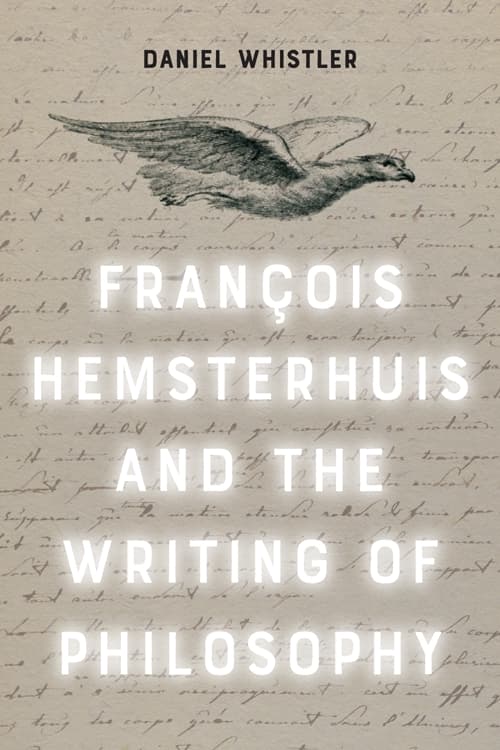
Francois Hemsterhuis and the Writing of Philosophy

Our ebooks are read in the Academic Reader app. After you buy, we’ll email you how to open your ebook in it.
Description
Resets the scholarship on the philosophical practice and style of François Hemsterhuis
- Only the second ever English-language monograph devoted to Hemsterhuis’ philosophy and the first for 45 years.
- Feeds into an upsurge of interest in Hemsterhuis around celebrations of the tricentenary of his birth and the publication of the first ever English translations of his writings by EUP.
- Makes substantial use of the recently published complete edition of Hemsterhuis’ correspondence.
- Focuses on Hemsterhuis’ uses of myth, dialogue and imagery in his late dialogues which were so influential on the later Idealists and Romantics, including Novalis and the Schlegels.
François Hemsterhuis (1721-1790) was the most significant Dutch philosopher after Spinoza. Daniel Whistler argues that Hemsterhuis’ philosophy matters and that its exclusion from the canon of modern philosophy has been unjust. This is not just because of its reception history - its influence on later German thinkers, such as Goethe, Hamann, Hegel, Herder, Hölderlin, Jean Paul, Kant, Jacobi, Novalis, Schelling, the Schlegels, Schleiermacher, Wieland - but is primarily because Hemsterhuis’ philosophy contains a rich assemblage of ideas and philosophical practices.
Whistler looks specifically at Hemsterhuis’ reflections on philosophical style and the strategies he employs to communicate ideas in his late dialogues. Taking seriously Hemsterhuis’ newly-published complete correspondence as a significant philosophical text, he contends that Hemsterhuis deserves to be placed alongside Shaftesbury, Hamann, Friedrich Schlegel, Kierkegaard and Nietzsche as one of the preeminent philosophical stylists of modernity.
Contents
Preface: Reasons to Read Hemsterhuis
Part One: Preliminaries
§1 Philosophy and Poetry
§2 Rupture
Part Two: Untimely Demands
Chapter One: Socrates and Newton
§3 ‘Born Greek’
§4 Geometrical Method
§5 A System of Times
Chapter Two: Analysis and Poetry
§6 ‘Poet-Philosophers’ and ‘Humble’ Analysts
§7 Sentimental Certainty
§8 The Platonic Sublime
§9 The Myth of Prometheus
Part Three: A History of Organs
Chapter Three: Organs, Instruments and Insects
§10 Insectification
§11 The Plasticity of Philosophy
§12 Perfectibility
§13 The Analogy to Morality
§14 Organology and Style
Chapter Four: Writing after Materialism
§15 Diderot Reads Hemsterhuis
§16 Hemsterhuis Reads Diderot
§17 Palingenesis and the Subversion of Materialism
§18 Post-Bonnetian Style
Part Four: Time-Images
Chapter Five: The Past and the Present
§19 The Optimum
§20 Epistolary Style
§21 Genealogy
§22 Irony and Anachronism
Chapter Six: The Archaic and the Prophetic
§23 Dreams and Shadows
§24 In the Style of Hope
Conclusion: Four Characters in Search of a Philosophy
Author
Reviews
In this lucid, erudite, and brilliant study, Whistler makes a compelling case for Hemsterhuis as a philosopher who—like Bruno, Kierkegaard, and Nietzsche—demands a reckoning, one whose thought is ripe for reappraisal: poetic and rigorous, speculative and scientific, untimely and thus a challenge and stimulus for the present.
Goes well with this book
From the same series or subject.
- Francois Hemsterhuis and the Writing of Philosophy, Ebook (EPUB), £25.99
- Spinoza and Art, Ebook (EPUB), £95.00
- Deleuze and Transcendental Empiricism, Ebook (EPUB), £110.00
More in Philosophy
View allEbook (EPUB)£110.00
Ebook (EPUB)£95.00
Ebook (EPUB)£150.00
Ebook (EPUB)£24.99