£19.99
Literary StudiesEdinburgh Critical Studies in Victorian Culture
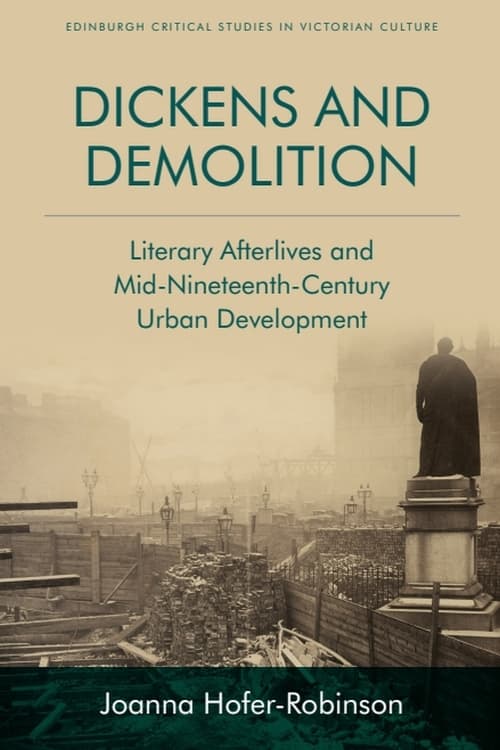
Dickens and Demolition
Literary Afterlives and Mid-Nineteenth-Century Urban Development

Our ebooks are read in the Academic Reader app. After you buy, we’ll email you how to open your ebook in it.
Description
Traces and measures the material impact of Dickens’ fiction in London’s built environment
Dickens and Demolition examines how tropes, characters, or extracts from Dickens’ fiction were repurposed as a portable terminology in arguments for large-scale demolition and redevelopment projects in London during his lifetime. Commentators with public voices repeatedly mobilised a Dickensian vocabulary to communicate their opinions about how and where London’s built environment should be improved in the mid-nineteenth century, or to justify proposed alterations. In analysing allusions to Dickens in a variety of archival sources, including dramatizations, press reports, political debates, and the visual arts, this book asks what cultural work is performed by literary afterlives, and whether we can trace their material effects in the spaces we inhabit.
Key Features- Intersects with cross-disciplinary scholarly interests in studies of Dickens, histories of London, literary afterlives and urban studies
- The first study of how Dickens’s works were appropriated and mobilised by other people within his lifetime
- Offers close analyses of literary and non-literary texts
- Engages with critical discourse around of literary afterlives
Contents
Abbreviations and a Note on Editions
List of Illustrations
Introduction
Chapter One
Charles Dickens and Metropolitan Improvements
Chapter Two
Sets and the City: Staging Oliver Twist and London
Chapter Three
Dickensian Afterlives and the Demolition of Field Lane
Chapter Four
Instrumental Writing: Paperwork, Philanthropy, and Dickens’s Involvement in Urban Improvements
Chapter Five
From Sanitary Reform to Cultural Memory: The Case of Jacob’s Island
Coda
Archival Sources and a Note on Method
Select Bibliography
Notes
Author
Reviews
Dickens and Demolition shows how Dickens shaped London. Not only was the novelist actively involved in urban sanitation schemes, but his fictional depiction of London's most deprived areas helped to bring down buildings, and construct new streets. As Hofer-Robinson vividly demonstrates here, novels have afterlives, and literary tropes sometimes have decidedly material effects.
Hofer-Robinson’s analysis of these adaptations is particularly refreshing because she offers original close readings of the texts themselves rather than defaulting to an account of Dickens’s reaction to his works being repurposed for the stage, a well-versed narrative.
An important contribution to our understanding of Dickens’s work and of Victorian London. Dickens and Demolition is profoundly and productively focused on the impact of fiction on the real, on the part literature has played in literally as well as discursively constructing the city. [...] Dickens and Demolition importantly reminds us how, all too often, society’s most vulnerable exist only in haunting absences.
Goes well with this book
From the same series or subject.
- Dickens and Demolition, Ebook (EPUB), £31.00
- The Americanisation of W. T. Stead, Ebook (EPUB), £90.00
- Narrative of the Life of Sir Walter Scott, Bart., Volume II, Ebook (EPUB), £125.00
From the same series
More in Edinburgh Critical Studies in Victorian Culture
£19.99
Ebook (EPUB)£90.00
Free to read
Read Time and Timelessness in Victorian Poetry
Ebook (EPUB)£24.99
Ebook (EPUB)£25.99
Ebook (EPUB)£20.99
Ebook (EPUB)£25.99
Ebook (EPUB)£20.99
Ebook (EPUB)£27.99
Ebook (EPUB)£27.99
Ebook (EPUB)£27.99
More in Literary Studies
View allEbook (EPUB)£125.00

Ebook (EPUB)£110.00

Ebook (EPUB)£90.00
Ebook (EPUB)£90.00

Ebook (EPUB)£90.00