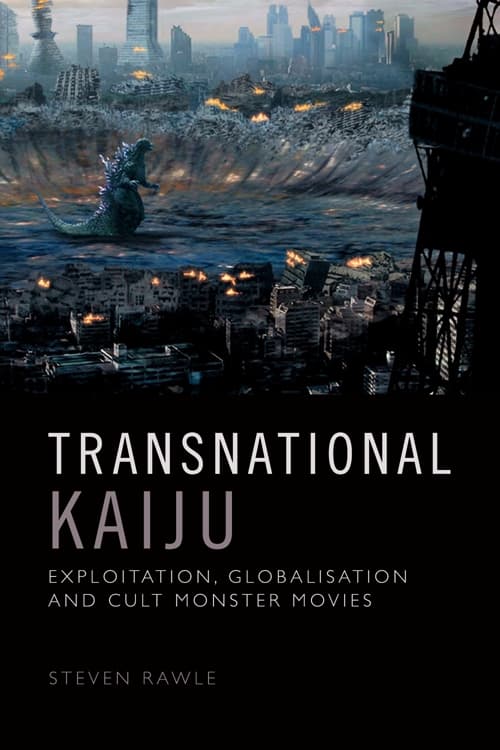
Transnational Kaiju
Exploitation, Globalisation and Cult Monster Movies

Our ebooks are read in the Academic Reader app. After you buy, we’ll email you how to open your ebook in it.
Description
- Focusses on a largely non-Hollywood genre
- Examines the ways in which globalisation has contributed to the spread and popularisation of the genre
- Explores the means by which fandoms contribute to the understanding of global genres
- One of very few academic texts to treat the kaijū eiga seriously
From relatively humble beginnings in a King Kong-inspired Japanese studio picture, the kaijū eiga has developed into a global genre. While the origins of giant kaijū – the term often preferred to ‘monster’ – remain firmly rooted in Japan, the figure has become a transnational spectacle. This book explores how kaijū went global, from the adoption of Godzilla movies in translation to the appropriation of cultural material across borders. With reference to the genre’s global development, its exploitative Western circulation and the labour of fans, the book examines how genres with deep national roots can become transnational phenomena.
Contents
Introduction: ‘Every Country has a Monster’
What is the kaijū eiga?
Cult Movies
Transnational Cinema
Transnational Kaijū
Chapter 1: National Films, Transnational Monsters
Kaijū and the Japanese National Imaginary
Carl Denham’s Giant Monster
The Lost World and The Beast
Kaijū emerge
Chapter 2: The First Monster Boom
Kaijū at Tōhō
Kaijū at Daiei
Kaijū at Shōchiku, Nikkatsu and Toei
Chapter 3: Exchanging monsters: Korean Kaijū
The kaijū meme
Kaijū head west
Kaijū on the Korean Peninsula
Kim Jong-Il’s kaijū
Kaijū in new Korean Cinema
Chapter 4: Distributing Kaijū: Localisation and Exploitation
National Cinema: Quality and Trash
Popular Cinema to Exploitation Film
Long Live the King
Cozzilla
The Return of Steve Martin
Chapter 5: ‘Paul Bunyan never fought Rodan’
Appropriation, Borrowing, Exchange
European Kaijū
Hollywood Kaijū
Kaijū Mockbusters
Kongsploitation
Chapter 6: Legendary Monsters
Legendary Entertainment
Marked/Unmarked Transnational Cinema
Pacific Rim
The Great Wall
Pacific Rim: Uprising
Into the MonsterVerse
Conclusion: The Limiting Imagination of Transnational Monsters
National Kaijū
Nostalgia and fandom
Author
Reviews
Across six chapters, [Rawle] provides in-depth analyses of the first Godzilla movie and the subsequent monster-movie boom in Japan; kaijū film in the two Koreas; the Western localization of Japanese kaijū films and production of domestic variants; kaijū as cult and exploitation cinema; and kaijū in Hollywood. [Rawle] does a good job of detailing the complex relationships—economic, industrial, and semiotic—between national cinema and transnational culture. Its study of international film distribution networks is particularly strong.
Across six chapters, [Rawle] provides in-depth analyses of the first Godzilla movie and the subsequent monster-movie boom in Japan; kaijū film in the two Koreas; the Western localization of Japanese kaijū films and production of domestic variants; kaijū as cult and exploitation cinema; and kaijū in Hollywood. [Rawle] does a good job of detailing the complex relationships—economic, industrial, and semiotic—between national cinema and transnational culture. Its study of international film distribution networks is particularly strong.
Since its 1954 debut, Godzilla’s heritage has undergone numerous makeovers. Steve Rawle has written an indispensable book on the many inspirations and transitions of the Kaiju. Detailing dozens of Kaiju films, Rawle gives an exquisite outline of the conditions of global connectivity and cultural appropriation that have coloured the cult phenomenon’s national and international travels, and of the themes that travel spawned, making Transnational Kaiju’s essential reading for fans, critics and scholars of what is still the best monster ever.
In a break from previous literature on the subject, Steven Rawles provides readers with what could be considered the authoritative work on how a niche genre of film tapped into a central mythos and transcended national borders to become a global phenomenon. Well-researched, it has enough information about kaiju-eiga films to remain interesting and accessible to recently joined fans of the genre, while at the same time giving veterans fresh subject matter to explore.
In Transnational Kaiju, Steve Rawle charts, with authority and rigour, the provenance and global development of this most culturally rich of popular genres. Attuned to both its local specificity and cultural elasticity, Rawle’s analysis is far-reaching in its assessment of the kaiju eiga as a truly transnational phenomenon.
Goes well with this book
From the same series or subject.
- Transnational Kaiju, Ebook (EPUB), £25.99
- Adapting American Adulthood, Ebook (EPUB), £90.00

- Isabelle Adjani, Ebook (PDF), £19.99

More in Film Studies
View all
Ebook (EPUB)£90.00
Ebook (PDF)£19.99

Ebook (EPUB)£95.00
£24.99