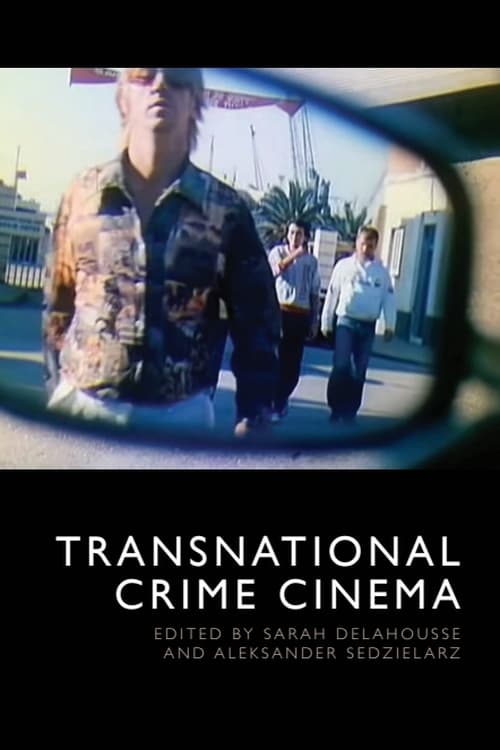
Transnational Crime Cinema

Our ebooks are read in the Academic Reader app. After you buy, we’ll email you how to open your ebook in it.
Description
- Demonstrates that representations of crime in cinema are part of an ongoing recognition and reordering of relations of power at the levels of individual, collective, and state
- Offers new angles on the work of a diverse set of directors and films connected through an attraction to crime narrative
- Tracks the changing scope and influence of transnational crime through studies of changing patterns of production moving through film, video and digital streaming that reveal cinema’s place within larger transnational structural and economic change
- Contains original research on social, political, and economic aspects of popular film that connects to topics in cultural studies, area studies (especially Latin America, the Balkans, South and East Asia, and the Middle East), and new media studies
- Offers a theory of filmic transnationalism in which cinema has coevolved with a neoliberal order of government actors and criminal organizations, as well as oligarchic and corporate regimes
Framed by approaches in critical transnationalism, this volume examines crime as a cinematic mode moving within, between, and across national cinemas to provide rigorous accounts of the political, economic, and historical processes entangled in the production, circulation, and reception of crime films most frequently treated through the lens of genre.
Filmic narratives of crime open a porous space of public discourse in which filmmakers and audiences project and reimagine relations of power. Transnational Crime Cinema studies the production and reception of films from Europe, Africa, East and South Asia, and South America present crime as a discursive site where the terms of the nation and cinema gain new definition.
Considered transnationally, crime cinema is a self-reflexive modality through which cinema reflects upon cinema’s own discursivity while audiences negotiate ideologies and imaginaries of nation against disruptive transnational economic and political pressures.
Contents
List of Figures Acknowledgements
Introduction - Aleksander Sedzielarz and Sarah Delahousse
Section 1: Transcription
1. Illuminating the Black Film: The Weimar Origins of the Argentine Policial, the Curious Case of ‘El Metteur’ James Bauer and Crime as Transnational Signifier - Aleksander Sedzielarz
2. Retracing Mafia Locality - David Rodríguez Martínez
3. Funhouse Noir: Escapist Expressionism in Samuel Khachikian’s Delirium - Ramin Sadegh Khanjani
Section II: Transgression
Part I: On the Boundaries of Nation and Ideology: Criminal Heroes at the Discursive Limits of Genre, Gender and the Body
4. Crime Without Borders: Marginality and Transnational Power in Jacques Audiard’s Un prophète - Julianna Blair Watson
5. Three Crime Films by Jia Zhangke: A Transnational Genealogy of Social and Personal Turmoil - Eren Odabasi
6. Tit for Tat: Avenging Women and Self-Fashioning Femininity in Malayalam Cinema - Rohini Sreekumar and Sony Jalarajan Raj
Part II: Modes of Transgression vis-à-vis State Repression and Violence
7. Communist Noir: The Hunt for Hidden Traitors, Saboteurs, Spies, Revisionists, and Deviationists in Albania’s Revolutionary Vigilance Films of the 1970s and 1980s - Jonida Gashi8. The Short Arm of the Law: The Post-Dictatorship Crime Film as a Barometer for Justice in Contemporary Argentina - Jennifer Alpert
9. The Case of the Spanish Gialli: Crime Fiction and the Openness of Spain in the 1970s - Fernando Gabriel Pagnoni Berns
Section III: Transvaluation
10. Franchising the Female Hero: Translating the New Woman in Victorin Jasset’s Protéa (1913), France’s First Female Spy Film - Sarah Delahousse
11. Shirkers (2018) Lost and Found?: Tracing Transsensorial Trauma in a True-Crime Road Movie - Jiaying Sim
12. Gated Crimes: Neoliberal Spaces and the Pleasures of Paranoia in Las viudas de los jueves (2009) and Betibú (2014) - Jonathan Risner
13. Ensemble of Experts: Relentless as ‘Nigerian Noir’ - Connor Ryan
Postscript: Desires for Transit and Mobile Genealogies of Popular Cinema - Aleksander Sedzielarz and Sarah Delahousse
Authors
Reviews
Always stressing the multiple and disparate over the unified and fixed, this challenging and illuminating collection of essays constructs an original, transnationally disruptive and refreshing mobile genealogy of crime cinema.
In this stunning collection, Delahousse and Sedzielarz do not round up the usual suspects. Instead, they compile an international police blotter written by stellar investigators tracking a globe-trotting and time-traveling crime spree spanning four continents. Revealed in film histories that cross borders and genres corruption connects nations, politics, capital and culture. From Albania to Nigeria, Iran, Italy, India, China, France and beyond, hidden bodies surface to implicate cinema itself in various crimes of the century: Stalinist show trials, fascist dictatorships, ruthless capitalist exploitation.
Goes well with this book
From the same series or subject.
- Transnational Crime Cinema, Ebook (EPUB), £25.99
- Adapting American Adulthood, Ebook (EPUB), £90.00

- Isabelle Adjani, Ebook (PDF), £19.99

More in Film Studies
View all
Ebook (EPUB)£90.00
Ebook (PDF)£19.99
Ebook (EPUB)£95.00
£24.99