Ebook (EPUB)£85.00
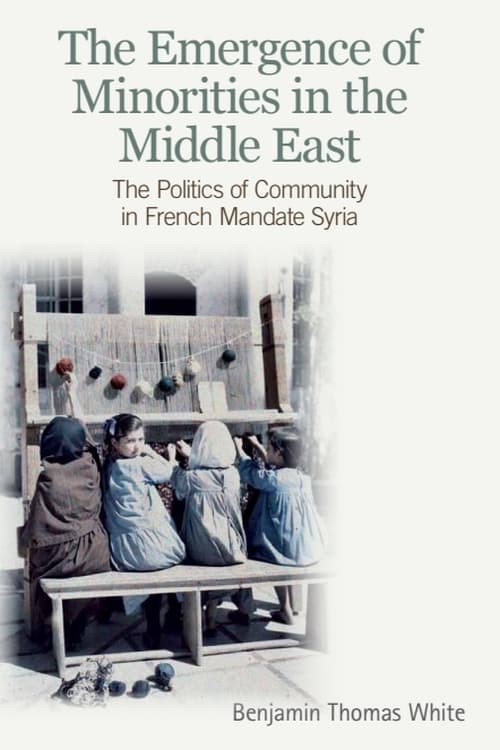
The Emergence of Minorities in the Middle East
The Politics of Community in French Mandate Syria

Our ebooks are read in the Academic Reader app. After you buy, we’ll email you how to open your ebook in it.
Description
Honorable Mention from the 2012 British-Kuwait Friendship Society Book Prize
Why, in the years around 1920, did the concept of 'minority' suddenly spring to prominence in public affairs worldwide? Within a decade of World War One, the term became fundamental to public and academic understandings of national and international politics, law, and society: 'minorities', and 'majorities' with them, were taken to be an objective reality, both in the present and the past.
This book uses a study of Syria under the French mandate to show what historical developments led people to start describing themselves and others as 'minorities'. Despite French attempts to create territorial, political, and legal divisions, the mandate period saw the consolidation of the nation-state form in Syria: a trend towards a coherent national territory with fixed borders, uniform state authority within them, and the struggle to control that state played out in the language of nationalism - developments in the post-Ottoman Levant that closely paralleled those in contemporary Europe, after the demise of the Austro-Hungarian and tsarist empires. Through close attention to what changed in French mandate Syria, and what those changes meant, the book argues for a careful rethinking of a term too often used as an objective description of reality.
Contents
Map 1. Syria c.1936; Map 2. The Far Northeast of Syria in the 1930s; Outline Chronology of the French Mandate, 1919-39; Acknowledgements; Introduction; Part I; 1. Minorities, Majorities and the Nation-state; 2. 'Minorities' and the French Mandate; Part II; 3. Separatism and Autonomism; 4. The border and the Kurds; Part III; 5. The Franco-Syrian Treaty and the Definition of 'Minorities'; 6. Personal Status Law Reform; Conclusion: Minorities, Majorities and the Writing of History; Select Bibliography; Index.
Author
Reviews
The Emergence of Minorities in the Middle East is a fine example of history writing as myth-busting, one that has significance for understanding current events in Syria as well as for the comparative study of the pivotal role of the modern nation-state in shaping national and subnational identities.
White’s work is a welcome case-study of communal politics in Mandate Syria. Its greatest contribution, however, lies in the author’s ability to weave together layers of local, colonial and international legal discourses, giving voice to a myriad of historical actors. Most importantly, the book links state-building processes to international legal innovations which mandated ‘minority protection’ as a prerequisite for independence and membership in the newly-established League of Nations. Here, the author makes a significant contribution to the often Eurocentric historiography of interwar minority politics and treaties...White has produced a work that is a must-read, not only for scholars of the Middle East, but also for the general public interested in placing contemporary events in general, and regional sectarian politics in particular, into the wider historical context.
White’s work is a welcome case-study of communal politics in Mandate Syria. Its greatest contribution, however, lies in the author’s ability to weave together layers of local, colonial and international legal discourses, giving voice to a myriad of historical actors. Most importantly, the book links state-building processes to international legal innovations which mandated ‘minority protection’ as a prerequisite for independence and membership in the newly-established League of Nations. Here, the author makes a significant contribution to the often Eurocentric historiography of interwar minority politics and treaties...White has produced a work that is a must-read, not only for scholars of the Middle East, but also for the general public interested in placing contemporary events in general, and regional sectarian politics in particular, into the wider historical context.
“…a very valuable addition to the history of the mandate period in Syria… highly relevant for providing a historical background to contemporary debates about states, ‘minorities’ and foreign intervention in Turkey and the Middle East”.
At the present time, when the language of majority-minority is very much at the forefront of political discourse in and about Syria, and when the future contours of the Syrian state are in flux, White’s study helps readers to understand how 'the politics of community' developed in early 20th-century Syria. The Emergence of Minorities in the Middle East is an antidote to interpretations of the Syrian present that depend on an uncritically primordialist reading of the country’s past.
Enjoyable and insightful… [A] fine work.
We often think that modern nation-states suppress other collective identities identities, but this thought-provoking book turns that assumption on its head, showing how fluid regional and religious identities were constituted as “minorities” through the very process of state-building. Scholars interested in the relationship between collective mobilization and political institutions will want to read this book.
Goes well with this book
From the same series or subject.
- The Emergence of Minorities in the Middle East, Ebook (EPUB), £31.00
- Biography of an Ottoman Provincial Town, Ebook (EPUB), £85.00
- Demographic Anxiety in Turkey, Ebook (EPUB), £90.00
More in IMES
View allEbook (EPUB)£90.00

Ebook (EPUB)£14.99
Ebook (EPUB)£100.00

Ebook (EPUB)£95.00