£24.99
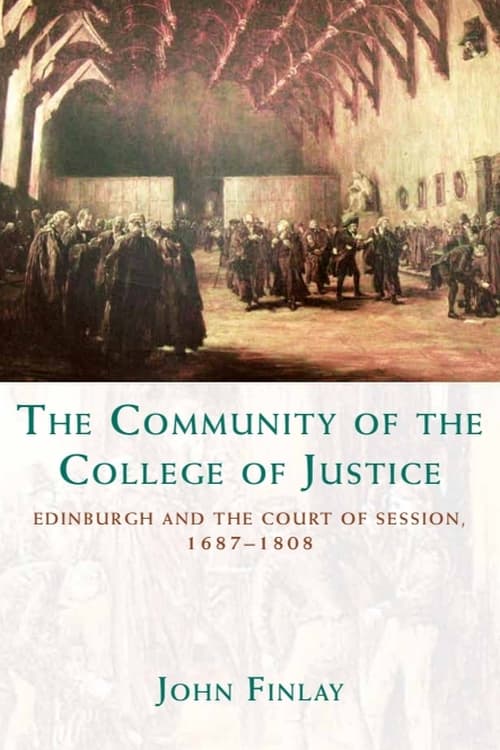
The Community of the College of Justice
Edinburgh and the Court of Session, 1687-1808

Our ebooks are read in the Academic Reader app. After you buy, we’ll email you how to open your ebook in it.
Description
The first institutional history of Scotland’s 18th-century civil court and its legal community
- An original and wide-ranging study based on primary sources, including newly discovered records from the Court of Session
- Gives you insights into the history of urban administration, the legal profession and the Court of Session
- Considers the legal and social community responsible for the development of Scots law at a key period in its development
- For anyone studying the sources and singularity of Scots Law, and the social history of the 18th century
- Read and download the introduction to The Community of the College of Justice online for free
This study investigates the important role of Scotland's College of Justice members in the cultural and economic flowering of Scotland as a whole, and Edinburgh in particular, and argues that a single Law institution had a marked influence on the Scottish cultural landscape to the present day. The Court of Session records, uncovered by John Finlay, show a cross-section of Scottish society experiencing Edinburgh’s legal processes in the 18th century.
18th-century Edinburgh owed much to the men who worked in the Court of Session as members of the unique institution known as the College of Justice. James Boswell, Lord Kames, Henry Dundas and Walter Scott are just some of those who emerged from the College to influence Scotland’s place in Europe.
Contents
Acknowledgements; Abbreviations and references; 1. Introduction; 2. The College and the Urban Community; 3. The College and Urban Administration; 4. The Lords of Session; 5. Advocates; 6. Writers to the Signet; 7. The Working Chambers of the College; 8. Subordinate and Minor Office-holders in the College; 9. Conclusion; Appendix 1; Appendix 2; Appendix 3; Bibliography; Index of subjects; Index of persons; Index of judicial titles.
Author
Reviews
John Finlay's latest book provides a vivid insight into the unique history of Scotland's College of Justice. Finlay has undertaken painstaking archival research to make this work a rich and original contribution to Scottish legal history. His work draws fascinating conclusions as to how the College shaped Edinburgh and Scotland, both socially and legally.... This book is therefore recommended as an essential read for students and researchers interested in both Scottish legal or social history. Finlay explicitly encourages the greater use of legal sources by historians, and believes that much can be learnt about "social and political attitudes" and "life in general" from such sources (p.257). He has provided a perfect starting point for such interdisciplinary work.
John Finlay's latest book provides a vivid insight into the unique history of Scotland's College of Justice. Finlay has undertaken painstaking archival research to make this work a rich and original contribution to Scottish legal history. His work draws fascinating conclusions as to how the College shaped Edinburgh and Scotland, both socially and legally ... This book is therefore recommended as an essential read for students and researchers interested in both Scottish legal or social history. Finlay explicitly encourages the greater use of legal sources by historians, and believes that much can be learnt about 'social and political attitudes' and 'life in general' from such sources (p.257). He has provided a perfect starting point for such interdisciplinary work.
Those already familiar with John Finlay’s work will be aware of his expert scholarship. This book is a testament to the breadth of his knowledge and the erudition of his research. It is clearly the product of painstaking examination of diverse sources from various libraries and archives. His analysis of statistical information drawn from these sources is, as ever, fascinating. Finlay couples this information with many enlightening anecdotes about the ordinary and extraordinary practices of various College members and other relevant events which occurred during this period. Overall, this book significantly enhances current understanding of the careers of the members of the College, the administration and expectations of their offices, and the interactions between members and with the wider city. Finlay presents this information in a clear and accessible manner, and is careful to define technical legal or procedural terms. Thus this book is not only of interest to scholars of legal history, but is also suitable for students and other interested parties.
Those already familiar with John Finlay’s work will be aware of his expert scholarship. This book is a testament to the breadth of his knowledge and the erudition of his research. It is clearly the product of painstaking examination of diverse sources from various libraries and archives. His analysis of statistical information drawn from these sources is, as ever, fascinating. Finlay couples this information with many enlightening anecdotes about the ordinary andextraordinary practices of various College members and other relevant events which occurred during this period. Overall, this book significantly enhances current understanding of the careers of the members of the College, the administration and expectations of their offices, and the interactions between members and with the wider city. Finlay presents this information in a clear and accessible manner, and is careful to define technical legal or procedural terms. Thus this book is not only of interest to scholars of legal history, but is also suitable for students and other interested parties.
‘Quite apart from providing the most thorough account available of the legal profession in the eighteenth century, The Community of the College of Justice also provides firm foundations for further study of the development of the law itself.’
Recommended as an essential read for students and researchers interested in both Scottish legal or social history.
Dr. Finlay’s book is the culmination of many years of painstaking research in the primary sources, and it presents a useful survey of the subject… This is a book of permanent authority which will be widely read and one which records the legal history of Scotland; it will be relied on for many generations.