
Ebook (EPUB)£125.00
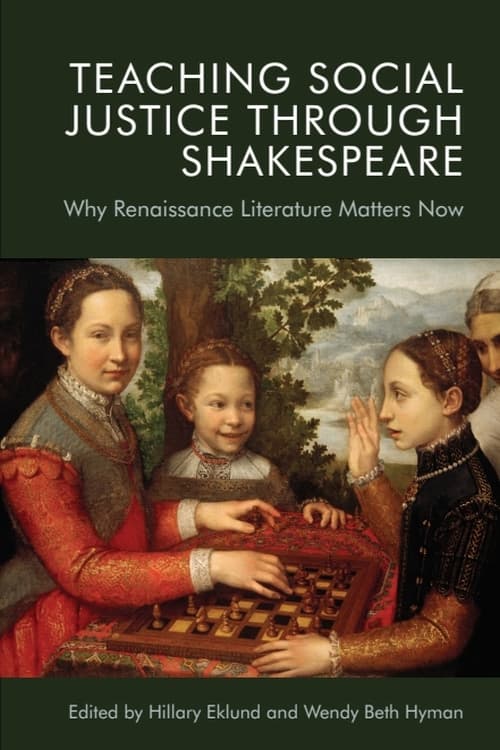
Teaching Social Justice Through Shakespeare
Why Renaissance Literature Matters Now
Open access
Open access under CC-BY-NC-ND 4.0
Description
New ideas for teaching contemporary social justice through Shakespeare and Renaissance literature
- Describes innovative and portable teaching methods informed by recent scholarship in early modern literature, cultural studies, and critical pedagogy
- Offers strategies for effective teaching and advocacy amidst the growing cultural and economic complexities of higher education
- Demonstrates the relevance of historical literary study to contemporary cultural conversations, especially those about social justice
- Historicizes the malicious "whitening" of Shakespeare and European culture, recognizing instead multiple, multicultural, accessible Shakespeares
- Presents Shakespeare’s plays as a common corpus of great value to democratic conversations in widely divergent contexts
- Gives educators language for promoting the virtue of humanistic inquiry and when higher education is on the defensive
This book is for teachers who want to heighten the intellectual impact of their courses by using their classrooms as a creative space for social formation and action. Its twenty-one chapters provide diverse perspectives on Shakespeare and early modern literature that engage innovation, collaboration, and forward-looking practices. They model ways of mobilizing justice with early modern texts and claim the intellectual benefits of integrating social justice into courses. The book reconceives the relationship between students and Renaissance literature in ways that enable them – and us – to move from classroom discussions to real-life applications.
Contents
AcknowledgmentsNotes on the contributors Introduction: Making Meaning and Doing Justice with Early Modern Texts, Wendy Beth Hyman and Hillary Eklund
Part I: Defamiliarizing Shakespeare
1. Topical Shakespeare and the Urgency of Ambiguity, Adhaar Noor Desai2. Shakespeare in Transition, Sawyer Kemp3. Shakespeare in Japan: Disability and a Pedagogy of Disorientation, Allison P. Hobgood 4. Global Performance and Local Reception: Teaching Hamlet and More in Singapore, Emily Griffiths Jones
Part II: Decolonizing Shakespeare
5. African-American Shakespeares: Loving Blackness as Political Resistance, Jason M. Demeter6. Chicano Shakespeare: the Bard, the Border, and the Peripheries of Performance, Ruben Espinosa7. "Intelligently organized resistance": Shakespeare in the Diasporic Politics of John E. Bruce, Kim F. Hall
Part III: Ethical Queries and Practices8. Sexual Violence, Trigger Warnings, and the Early Modern Classroom, Kirsten Mendoza9. Rural Shakespeare and the Tragedy of Education, Jeffrey Osborne10. Shakespearean Tragedy, Ethics, and Social Justice, Mary Janell Metzger11. Teaching Environmental Justice and Early Modern Texts: Collaboration and Connected Classrooms, Rebecca Laroche and Jennifer Munroe12. Failing with Shakespeare: Political Pedagogy in Trump’s Autumn, Steve Mentz
Part IV: Revitalizing the Archive and Remixing Traditional Approaches
13. Teaching Serial with Shakespeare: Using Rhetoric to Resist, Rachel E. Holmes14. Adjunct Pleasure: Shakespeare’s Sonnets and the Writing on the Walls, Matthew Harrison15. Confronting Bias and Identifying Facts: Teaching Resistance Through Shakespeare, Carla Della Gatta16. Literary Justice: The Participatory Ethics of Early Modern Possible Worlds, Debapriya Sarkar
Part V: Shakespeare, Service, and Community
17. Shakespeare, Service Learning, and the Embattled Humanities, Hillary Eklund18. Teaching Shakespeare Inside-Out: Creating a Dialogue Between Traditional and Incarcerated Students, Jayme M. Yeo19. "‘Shakespeare’ on his lips": Dreaming of The Shakespeare Center for Radical Thought and Transformative Action, Eric L. De Barros20. From Pansophia to Public Humanities: Connecting Past and Present Through Community-Based Learning, Tania Boster21. Cultivating Critical Content Knowledge: Early Modern Literature, Pre-Service Teachers, and New Methodologies for Social Justice, Todd Butler and Ashley Boyd
Afterword, Ayanna ThompsonBibliographyIndex
Authors
Reviews
Teaching Social Justice Through Shakespeare felt urgently needed in 2019. Writing this review in the summer of 2020 [...] the urgency feels so much the greater. Eklund and Hyman have assembled an extraordinary array of essays, ones that draw Shakespeare into discussions of (among other things) race, gender and gender identity, disability, incarceration, and environmental devastation.
Eklund and Hyman brilliantly demonstrate how Shakespeare can be an instrument of social justice, providing a common discourse that unites communities, yet one that can defamiliarize and disrupt current systems of power and knowledge. If Shakespeare’s work has sometimes been enlisted as a vehicle of structural oppression, the essays in this volume reveal its value for pedagogies that resist, transform, and impel action.
It would be difficult to overstate the importance of Hilary Eklund and Wendy Beth Hyman’s Teaching Social Justice Through Shakespeare: Why Renaissance Literature Matters Now. This collection will no doubt serve as an essential resource to any instructor who wants to restructure a Shakespeare course in foundational ways. [...] This is the most timely and relevant book that professors can read right now.
This collection inspires the possibility that we might make new kinds of common ground from Shakespeare by creating learn-ing experiences for our students that help them build just relations to others around the planet. A matrix of globally connected class-rooms could help students understand and participate in social justice projects that they could perhaps not even imagine before our classrooms begin to serve them as portals to the world—portals from which, with new “terrestrial” pedagogies, pedagogies of grace, we may have some hope of saving one another, and the planet.
Goes well with this book
From the same series or subject.
More in Literary Studies
View allEbook (EPUB)£110.00
Ebook (EPUB)£90.00
Ebook (EPUB)£90.00
Ebook (EPUB)£90.00