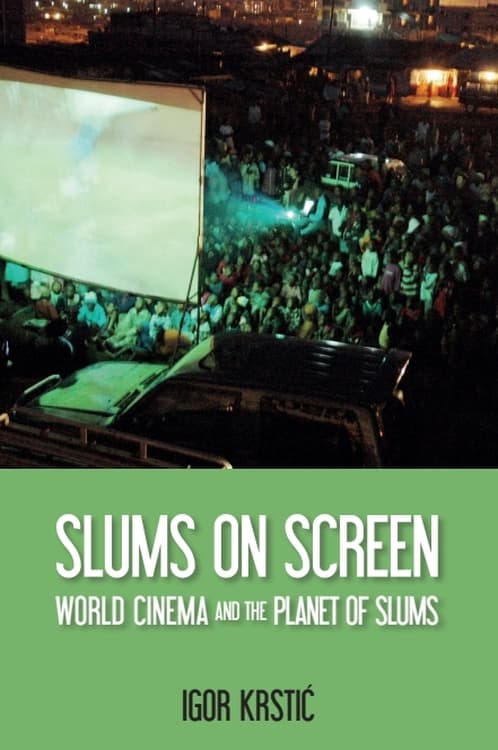
Description
A polycentric approach to the representation of slums in world cinema
Near to one billion people call slums their home, making it a reasonable claim to describe our world as a ‘planet of slums.’ But how has this hard and unyielding way of life been depicted on screen? How have filmmakers engaged historically and across the globe with the social conditions of what is often perceived as the world’s most miserable habitats?
Combining approaches from cultural, globalisation and film studies, Igor Krstic outlines a transnational history of films that either document or fictionalise the favelas, shantytowns, barrios poulares or chawls of our ‘planet of slums’, exploring the way accelerated urbanisation has intersected with an increasingly interconnected global film culture. From Jacob Riis’ How The Other Half Lives (1890) to Danny Boyle’s Slumdog Millionaire (2008), the volume provides a number of close readings of films from different historical periods and regions to outline how contemporary film and media practices relate to their past predecessors, demonstrating the way various filmmakers, both north and south of the equator, have repeatedly grappled with, rejected or continuously modified documentary and realist modes to convey life in our ‘planet of slums’.
Key Features
- Traces the global flows of film culture through emphasising the transnational impact of important film movements
- Focuses on two important ‘cinematic megacities’ (Rio de Janeiro and Mumbai) to outline how global film cultural currents become modified according to a specific local context
- Combines approaches from cultural, globalisation and film studies to reconstruct world cinema’s ‘planet of slums’
- Adds a new perspective on cultural (world cinema) and social (cityward migration) globalisation processes
Contents
AcknowledgementsIntroduction1: Slums on and off Screen
Part One: Global Currents2: Sensational Remediations3: Documentary Mappings4: Neorealist Narratives5: Third Docufictions6: Postmodern Bricolages7: Digital Realisms
Part Two: Local Expressions8: Favelas on Screen9: Bombay Cinema
ConclusionBibliographySelect Filmography
Author
Reviews
This lucid and necessary study offers a breathtaking coverage of more than a hundred years of slums in film. Igor Krstic undertakes an in-depth scrutiny of handpicked examples of the various phases of slums on screen worldwide, in the light of a rigorous, polycentric and cross-mediatic methodology. Fearlessly confronting the debates around the ethics of representing the underprivileged, Igor Krstic rises, with this book, to the forefront of film studies today.
This book skilfully provides a detailed and wide-ranging account of slum representation across films drawn from most continents and spanning a timeframe of over one hundred years. Analytically too, the book engages with a range of academic thought from the politics of urbanisation and globalisation to approaches drawn from cultural and film studies...[Slums on Screen] will be of great academic interest to scholars and students of development studies, urban politics, film studies and visual anthropology as well as to avid film fans.'
Undertaking nothing less than a genealogy of the representation of slums in popular media, harking back to the pre-cinematic era, Krstić has taken on a huge challenge. Cataloguing a large group of thematically connected films, he deftly analyses shifting and recurring currents across time and space in this absorbing and accessible study.
Krstić’s highly accessible book shines a perceptive light on an area of world cinema that has been surprisingly under-researched for too long in film studies. It offers a refreshing insight into the relationship between the evolution of film practice and slum presentation and representation... This would appeal to both early researchers and scholars who are interested in the growing scholarship of world cinema.'
Goes well with this book
From the same series or subject.


More in Film Studies
View all
Ebook (EPUB)£90.00
Ebook (PDF)£19.99
Ebook (EPUB)£95.00
£24.99