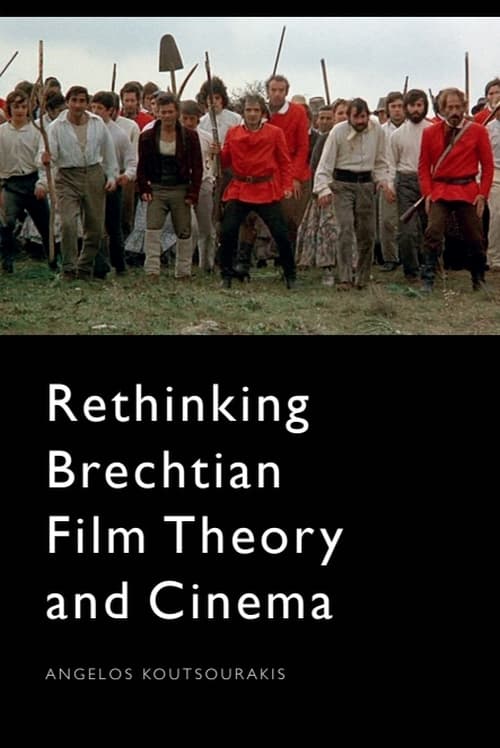
Rethinking Brechtian Film Theory and Cinema

Our ebooks are read in the Academic Reader app. After you buy, we’ll email you how to open your ebook in it.
Description
- Offers the first full‐length study on Brechtian film theory and cinema dedicated to connecting Brecht's writings with classical film theory, contemporary film theory and German Media Theory
- Seeks to connect theory with practice so as to identify the ways the dialectic works within the film object
- Investigates Brechtian cinema with reference to a variety of filmmakers who share aesthetic and cultural differences, but also similarities in their employment of the dialectical method
Making a compelling argument for the continuing relevance of Brechtian film theory and cinema, this book offers new research and analysis of Brecht the film and media theorist, placing his scattered writings on the subject within the lively film theory debates that took place in Europe between the 1920s‐1960s. Furthermore, Angelos Koutsourakis identifies key points of convergence between Brecht’s ‘unfinished project’ and contemporary film and media theory. With case studies of films ranging from Robert Roberto Rossellini’s Paisà to Bernardo Bertolucci’s 1900 and Joshua Oppenheimer’s The Act of Killing amongst others, this study challenges many existing preconceptions about Brecht’s theoretical position and invites readers to discover new ways of apprehending and making use of Brecht in film studies.
Contents
Acknowledgements
Introduction
Part 1: Brechtian Film Theory
Chapter 1: Key Concepts
The Dialectic
The Individual as a Nexus
The Gestic Principle: Between Brecht, Eisenstein, and Deleuze
Gestus and Cultural Techniques
‘Humour is a Sense of Distance’
Chapter 2: Photography and Film
The Photographic Image
The Apparatus and the Agency of the Machine
Chapter 3: Modernism as Realism
Brecht, Bazin, and LukácsOn Sound/Music
Some Thoughts on Brecht and Genre
Chapter 4: Brecht in Film Theory
From Close Up to the Grand TheoryNoël Burch
The Cognitivist Critique
Rancière and the post-Brechtian
Part 2: Brechtian Cinema
The Revisionist History Film
Chapter 5: Re-visioning History
Defining the Revisionist History Film
Totality is history: Szegénylegények (The Round-Up, 1966) and Allonsanfàn (1974)
Chapter 6: Revisiting National Traumas
Dealing with Fascism: Professor Mamlock (1961), Das schreckliche Mädchen (The Nasty Girl, 1990)
Epic Cinema: Ο Θίασος (The Travelling Players, 1975), 1900 (1976)
The Essay Film
Chapter 7: Beyond Auteurism: the Dialectics of the Essay Film
The Disappearance of the Subject in WritingRepresentation as Unfinished Material: Thomas Heise’s Material (2009)
Chapter 8: Pedagogical Essay Films
Agitprop and the Crisis: Brecht die Macht der Manipulateure (Break the Power of the Manipulators, 1967), Fascism Inc. (2014)
The Lehrstück on Film: La Commune (Paris, 1871) (2000), The Act of Killing (2012)
Cinemas of Cruelty
Chapter 9: Brecht and Artaud
The Politics of Cruelty: Brecht and ArtaudFrom Theatre to Film: The Brig (1964), Marat/Sade (1967)
Chapter 10: Cruelty as Anti‐commodity
Everyday Fascism: Import/Export (2007), The Rebellion of Red Maria (2011)The Postdramatic on Screen: Katzelmacher (1969), Die linkshändige Frau (The Left‐handed Woman, 1978)
Epilogue
Bibliography
Index
Author
Reviews
Rethinking Brechtian Film Theory and Cinema is an important study both for Brecht scholarship and film criticism. It not only demonstrates the continuing relevance of Brecht for cinema, it also returns to and literally "rethinks" established approaches. The theoretical work, in particular, is nothing short of formidable in its scope and depth.
Rethinking Brechtian Film Theory and Cinema is an important study both for Brecht scholarship and film criticism. It not only demonstrates the continuing relevance of Brecht for cinema, it also returns to and literally "rethinks" established approaches. The theoretical work, in particular, is nothing short of formidable in its scope and depth.
Brecht's experiences with film were not always happy, but the Brechtian influence on film and its theory is colossal. Koutsourakis’ book masterfully sets out the wide scope of Brecht's aesthetics, from his 1923 venture with slapstick to the Brechtian footprints in the essay film, Realist and post-Deleuzian cinema theory and contemporary media archaeology.
Goes well with this book
From the same series or subject.
- Rethinking Brechtian Film Theory and Cinema, Ebook (EPUB), £29.99
- Adapting American Adulthood, Ebook (EPUB), £90.00
- Isabelle Adjani, Ebook (PDF), £19.99
More in Film Studies
View all
Ebook (EPUB)£90.00
Ebook (PDF)£19.99
Ebook (EPUB)£95.00
£24.99