Ebook (EPUB)£23.99
Language & LinguisticsEdinburgh Studies in Theoretical Linguistics
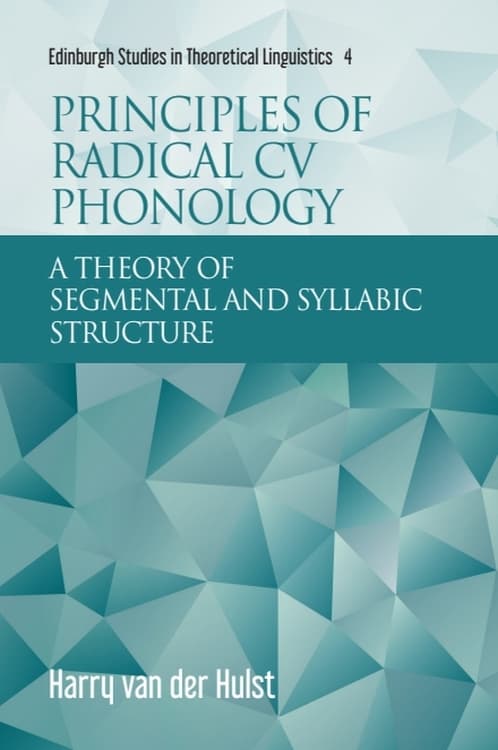
Principles of Radical CV Phonology
A Theory of Segmental and Syllabic Structure

Our ebooks are read in the Academic Reader app. After you buy, we’ll email you how to open your ebook in it.
Description
A new theory of the structure of phonological representations for segments and syllables
- Proposes a new theory of the structure of phonological representations for segments and syllables
- Presents detailed analysis of phonological contrast
- Introduces the central role of dependency relations in phonological structure
- Offers comparison to other models including Dependency Phonology and Government Phonology
Harry van der Hulst’s model of Radical CV Phonology has roots in the framework of Dependency Phonology, but proposes a rather different ‘geometry’, which reduces the set of unary elements to just two: |C| and |V|. The model explains the phonological distinctions that function contrastively in the world’s languages rather than presenting it as a ‘random’ list.
Van der Hulst shows how this model accounts for a number of central claims about markedness and minimal specification. He explains how the representational system accounts for phonological rules and shows how this theory can be applied to sign language structure. Through comparison to other models, he also provides insight into current theories of segmental structure, commonly used feature systems, as well as recurrent controversies.
Contents
Preface; List of abbreviations
Chapter 1. Basic assumptions about phonology
1.1 Introduction
1.2 What is phonology?
1.3 Six theses concerning phonological primes
1.4 Is phonology different?
1.5 Alternations and processes
1.6 Summary and concluding remarks
Chapter 2: Background: Dependency and Government Phonology
2.1 Introduction
2.2 Monovalency, grouping, dependency and contrastivity
2.3 Government Phonology
2.4 Toward Radical CV Phonology
2.5 Summary and Concluding remarks
Chapter 3: Radical CV Phonology
3.1 Introduction
3.2 An outline of Radical CV Phonology
3.3 Summary and Concluding remarks
Chapter 4: Manner
4.1 Introduction
4.2 Onset
4.3 Rhyme
4.4 Syllabic consonants (sonorants)
4.5 Long vowels, diphthongs and geminates
4.6 Summary and concluding remarks
Chapter 5: Place
5.1 Introduction
5.2 Edge (onset head): obstruents
5.3 Nucleus (rhyme head): vowels
5.4 Bridge and coda
5.5 Summary and concluding remarks
Chapter 6: Laryngeal: phonation and tone
6.1 Introduction
6.2 Edge (onset head): consonants (phonation)
6.3 Nucleus (rhyme head): vowels (tone)
6.4 Four issues
6.5 Bridge and coda
6.6 Summary and concluding remarks
Chapter 7: Special structures
7.1 Introduction
7.2 Incomplete structures
7.3 Overcomplete structures
7.4 Summary and Concluding remarks
Chapter 8: Predictability and preference
8.1 Introduction
8.2 Harmony
8.3 Preference ranking of segments per syllabic position
8.4 Preferred segmental systems
8.5 Summary and Concluding remarks
Chapter 9: Minimal specification
9.1 Introduction
9.2 A typology of redundant properties
9.3 Radical underspecification
9.4 Contrastive and radical underspecification in a unary framework
9.5 Markedness, complexity and salience
9.6 Examples of minimal specification
9.7 Can redundant elements become active?
9.8 Constraints and learnability
9.9 Summary and Conclusions
Chapter 10: RcvP applied to sign phonology
10.1 Introduction
10.2 The macro structure of signs
10.3 The micro structure of signs
10.4 Two-handed signs
10.5 What about syllable structure?
10.6 Summary and Concluding remarks
Chapter 11: Comparison to other models
11.1 Introduction
11.2 Feature Geometry Models
11.3 Other models
11.4 Summary and Concluding remarks
Chapter 12: Conclusions
12.1 Introduction
12.2 Goals and basic principles
12.3 X-bar structure everywhere
12.4 Strength and weakness
12.5 Do we need the element A after all?
12.6 What’s next?
References; Subject Index; Language Index
Author
Reviews
Principles of Radical cv Phonology is the culmination of many years of work and reflection on the nature of phonological representations. The theory, presented in a clear and thorough manner, builds on and synthesizes ideas from a number of different theoretical and descriptive approaches. Its comprehensive treatment of every major issue relating to the basic units of phonology makes this book a valuable resource for anyone with an interest in the cognitive organization of speech sounds and its relation to phonetics.
Goes well with this book
From the same series or subject.
- Principles of Radical CV Phonology, Ebook (EPUB), £27.99
- A Multi-locus Analysis of Arabic Negation, Ebook (EPUB), £23.99

- A Substance-free Framework for Phonology, Ebook (EPUB), £29.99
From the same series
More in Edinburgh Studies in Theoretical Linguistics
More in Language & Linguistics
View all
Ebook (EPUB)£19.99
Ebook (EPUB)£125.00
Ebook (EPUB)£105.00

Ebook (EPUB)£95.00

Ebook (EPUB)£90.00