Ebook (EPUB)£125.00
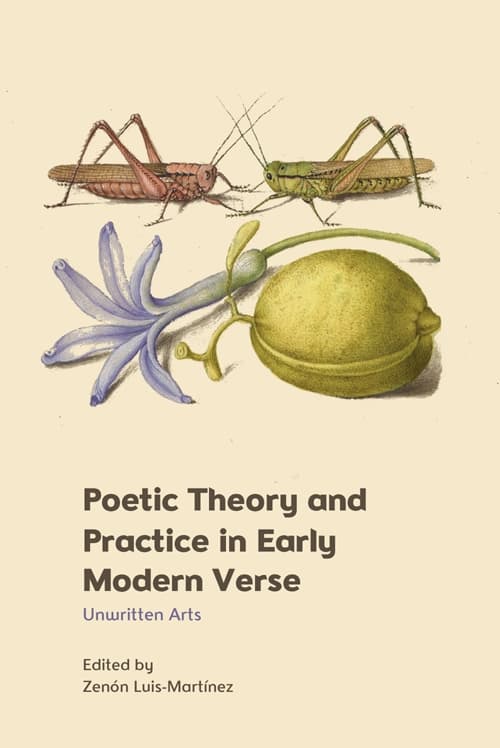
Poetic Theory and Practice in Early Modern Verse
Unwritten Arts
Open access
Open access under CC-BY-NC-ND 4.0
Description
Reinterprets the dialogue between theories and practices of poetry in early modern England
- Explores new perspectives on early modern poetic theory and practice
- Unearths key lexicons and notions of Renaissance poetics in early modern English poems
- Freshly rereads canonical poems and poets alongside less frequented authors and texts
- Reads early modern poetic texts in the larger intellectual contexts of Britain and Europe
- Brings together a transnational team of scholars on early modern English literature
How did ideas about the poet’s art surface in early modern texts? By looking into the intersections between poetry, poetics and other discourses – logic, rhetoric, natural philosophy, medicine, mythography or religion – the essays in this volume unearth notions that remained largely unwritten in the official literary criticism of the period. Focusing on questions of poetry’s origins and style, and exploring individual responses to issues of authenticity, career design, difficulty, or inspiration, this collection revisits and renews the critical lexicons that connect poetic theory and practice in early modern English texts and their European contexts. Reading canonical poets and critics – Sidney, Spenser, Marlowe, Shakespeare, Puttenham, Dryden – alongside less studied figures such as Henry Constable, Barnabe Barnes, Thomas Lodge, Aemilia Lanyer, Fulke Greville or George Chapman, this book extends the coordinates for a dialogue between literary practice and the Renaissance theories from which they stemmed and which they helped to outgrow.
Contents
Acknowledgements
Notes on Contributors
Introduction: Unwritten Arts – Zenón Luis-Martínez
I. Origin: Poetic Aetiologies 1: Justified by Whose Grace? Poetic Worth and Transcendent Doubt in Late Elizabethan and Early Jacobean Poetry – Joan Curbet Soler 2: The Logical Cause of an Early Modern Poetics of Action – Emma Annette Wilson3: Atomies of Love: Material (Mis)interpretations of Cupid’s Origin in Elizabethan Poetry – Cassandra Gorman
II. Style: Outgrowing the Arts4: Bloody Poetics: Towards a Physiology of the Epic Poem – Rocío G. Sumillera 5: Figuring Ineloquence in Sixteenth-Century Poetry – David J. Amelang 6: Eloquent Bodies: Rhetoricising the Symptoms of Love in the English Epyllion – Sonia Hernández-Santano
III. Poesis: Art’s Prisoners7: Philip Sidney’s Sublime Self-authorship: Authenticity, Ecstasy and Energy in the Defence of Poesy and Astrophil and Stella – Jonathan P. A. Sell 8: From Favour to Eternal Life: Trajectories of Grace and the Poetic Career in the Sonnets of Henry Constable and Barnabe Barnes – María Jesús Pérez-Jaúregui 9: Thomas Lodge’s ‘Supple Muse’: Imitation, Inspiration and Imagination in Phillis – Cinta Zunino-Garrido 10: The Worthy Knots of Fulke Greville – Sarah Knight 11: George Chapman’s ‘Habit of Poesie’ – Zenón Luis-Martínez
Afterword – Clark Hulse
Author
Reviews
While sixteenth-century England witnessed an explosion of works on poetics, some of the period’s most important and lasting ideas about literature emerge from poetry itself. As this collection reveals, practice not only leads theory but ‘unwrites’ it to unveil a living, pulsing art in which form outstrips all formulations.
Goes well with this book
From the same series or subject.
More in Literary Studies
View allEbook (EPUB)£110.00
Ebook (EPUB)£90.00
Ebook (EPUB)£90.00
Ebook (EPUB)£90.00