Ebook (EPUB)£85.00
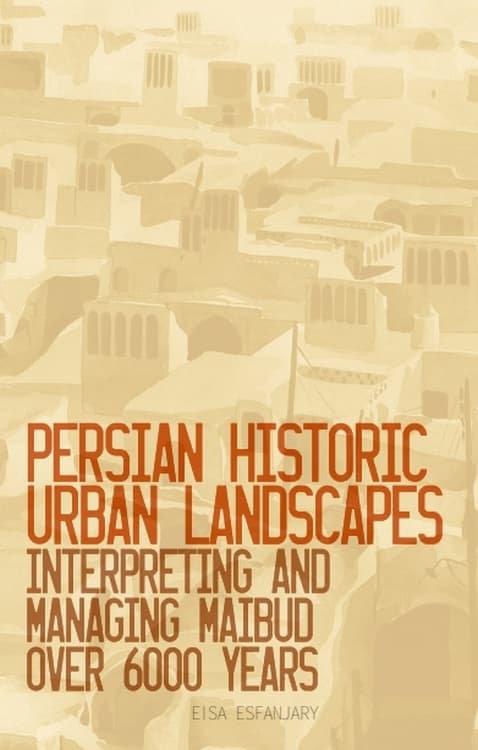
Persian Historic Urban Landscapes
Interpreting and Managing Maibud over 6000 Years

Our ebooks are read in the Academic Reader app. After you buy, we’ll email you how to open your ebook in it.
Description
The first urban study of the Iranian city of Maibud over its 6000-year history
Persian cities are part of a corridor of civilisation with settlements straddling thousands of years. Taking Maibud as a case study, Eisa Esfanjary traces the evolution of ancient settlements chronologically, thematically and methodologically.
Maibud provides the basis from which a new interpretive approach is developed, being a city that has a history of several millennia yet has a scale that renders it manageable with archaeological remains that range across several phases of building development. An archetypal example of middle-sized Persian cities, it affords insights into the entire urban landscape and its spatial, functional and morphological iterations. Within this overall picture, a methodology is developed to explore various morphological elements of the city, the three key components of which are the town plan, the building type, and construction materials. The inter-relationships between these three components are explained in order to formulate an approach to support the management and conservation of the historic urban landscape.
Combining a rigorous survey and observation of the standing structures with scarce archaeological and written sources, this book sheds light on Islamic urbanism in general and Islamic urbanism in Iran particularly.
Key Features- Organised in three main parts: a conceptual framework; the case study of Maibud; and an explanation of its wider significances, and potential policy applications
- Sheds new light on the development of one of ancient world’s oldest, yet least known, living cities in Iran, supported by highly original and convincing analysis
- Features case studies with new evidence, which require us to re-evaluate our understanding of urbanism not just in Iran but also in the wider Islamic world
- Illustrated with many images including maps, plans, line drawings, watercolours and colour photos
Contents
PrefaceAcknowledgmentsAbbreviationsGlossaryList of Illustrations
PART ONE: CONCEPTUAL FRAMEWORK 1. Introduction 2. Intellectual Boundaries3. Urban Morphology
PART TWO: CASE STUDY: MAIBUD4. Maibud’s Historic Urban Landscape5. Town Plan6. Building Type and Layering Processes7. Materiality
PART THREE: SYNTHESIS8. Interpretations and Conclusion
Bibliography
Author
Reviews
An original and exciting contribution to the history of the Iranian city. The author shows how much can be learned about changing styles of housing and urban planning in a discussion that is scholarly, but at the same time easy to read and understand. Everyone interested in the history and development of towns in Iran will certainly need to read it.
This is the first work on Iranian cities that combines both a long run account of development and a micro level of analysis.'
This is an ambitious and pioneering study of the evolution of an Iranian desert city over the millennia, enlivened by a deep understanding of its social context, the changing structural imperatives at work and the adaptability of brick as a building material.'
Goes well with this book
From the same series or subject.
- Persian Historic Urban Landscapes, Ebook (EPUB), £120.00
- Biography of an Ottoman Provincial Town, Ebook (EPUB), £85.00
- Demographic Anxiety in Turkey, Ebook (EPUB), £90.00
More in IMES
View allEbook (EPUB)£90.00

Ebook (EPUB)£14.99
Ebook (EPUB)£100.00
Ebook (EPUB)£95.00