Ebook (EPUB)£100.00
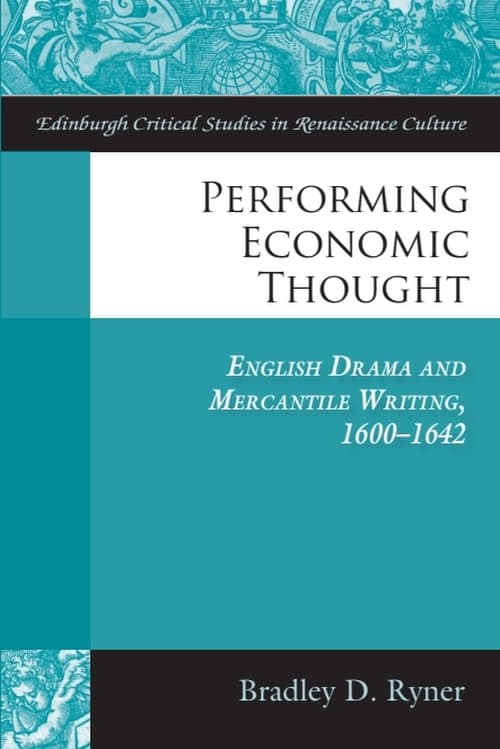
Literary StudiesEdinburgh Critical Studies in Renaissance Culture
Performing Economic Thought
English Drama and Mercantile Writing 1600-1642
1
Description
Provides an original account of the relationship between economic thought and early modern drama
Performing Economic Thought examines representations of economic exchange in English plays and mercantile treatises written between the chartering of the English East India Company in 1600 and the closing of the public playhouses at the outset of the English Civil War in 1642. These were crucial decades during which economic thinkers re-examined how they conceptualised and depicted commerce as a system.
Adapting approaches pioneered by scholars working under the expansive rubric of Science Studies, Performing Economic Thought compares the formal features of treatises and plays, giving particular attention to those features unique to the theatrical experience (for example, the presence of props and actors' bodies and the position of the audience relative to the staged action) that allowed economic systems to be represented and conceptualised differently in the playhouse than in the printed treatise. The book argues that the representational techniques available to playwrights facilitated a more insightful exploration of economic systems than those available to economic writers.
Contents
Introduction: Performing Economic Thought; Chapter 1. Tables and Metaphors: Mountfort’s The Launching of the Mary; Chapter 2. Overflowing Props: Massinger’s The Emperor of the East; Chapter 3. Characterising Economics: Middleton and Rowley’s The Changeling; Chapter 4. The Panoramic Stage: Shakespeare’s The Merchant of Venice and Cymbeline; Chapter 5. Stage-Managing Interpretation: Jonson’s The Staple of News; Chapter 6. Generic Self-Reflexivity: Brome’s A Jovial Crew; Chapter 7. The Performativity of Economic Models: Heywood’s If You Know Not Me, You Know Nobody, Part II and Massinger’s The Picture.
Author
Reviews
Innovative and ambitious, Ryner’s book demonstrates how early modern theatre staged economic thought. He brings economic and theatrical modes brilliantly into play with one another, and illuminates the relationships among cultural discourses, literary form, and the theatrical dimensions of the plays. This is an exciting book indeed.
Ryner’s brilliant book shows how the early modern playhouse was a laboratory in which emerging global systems were conceptualised, dissected, tested and reassembled. Ryner invites us to re-read canonical and non-canonical drama, from Shakespeare and Jonson to Massinger and Mountfort, as intimately engaged in thought experiments that ground what we now call the economic in the resources of theatrical representation itself.
Ryner ventures into well-travelled waters in Performing Economic Thought but happily he produces substantial returns on investment. Rather than approach the early modern ‘business’ of theatre in the manner of William Ingram and Melissa Aaron, or as a naturalizing representation of nascent capitalism à la Jean-Christophe Agnew or Richard Halpern, Ryner compares drama and mercantile writing between 1600 and 1642 as forms of knowledge. The result is compelling, well-documented, and lucidly written... Performing Economic Thought... demonstrates that the early modern stage could produce new knowledge about economic discourse, especially that economic writing is itself performative.
Ryner has staked out his own turf in this excellent book: he treats seriously economic thought in Renaissance drama, and illuminates the formal qualities of plays that display that thought. In the end, he is successful in his project to compare the efficacy of mercantilists’ economic models and playwrights’ plays: while both attempt to link individual actions to their systemic effects, plays’ more comprehensive, mediated and consciously constructed models successfully ‘teach’ audiences how to see complex socio-economic patterns and their consequences.
I wish there were more books like Bradley D. Ryner’s Performing Economic Thought... Ryner provides... a serious account of what literature and especially drama can do in the wider world of ideas. [...] This is the kind of book that speculatively inclined economists should (and could) read, and that every early modernist scholar of literature will want to sample.
Performing Economic Thought is an innovative investigation of theatrical technique and mercantilist discourse. Ryner provides lucid readings of dense economic treatises and cogent explications of demanding theoretical material. His objective of historicize the division between fact and fiction that has bought a privileged place for economics is important and ambitious.
Goes well with this book
From the same series or subject.
- Performing Economic Thought, Paperback, £19.99
- Women, Texts and Tombs after the Reformation, Ebook (EPUB), £100.00
- Instinct, Knowledge and Occult Science on the Early Modern English Stage, Ebook (EPUB), £90.00
From the same series
More in Edinburgh Critical Studies in Renaissance Culture
£24.99
Ebook (EPUB)£90.00
Ebook (EPUB)£95.00
Ebook (EPUB)£19.99
Ebook (EPUB)£19.99
Ebook (EPUB)£14.99
Ebook (EPUB)£29.99
Ebook (EPUB)£19.99
Ebook (EPUB)£24.99
More in Literary Studies
View all
Ebook (EPUB)£125.00
Ebook (EPUB)£110.00
Ebook (EPUB)£90.00
Ebook (EPUB)£90.00
Ebook (EPUB)£90.00