Ebook (EPUB)£85.00
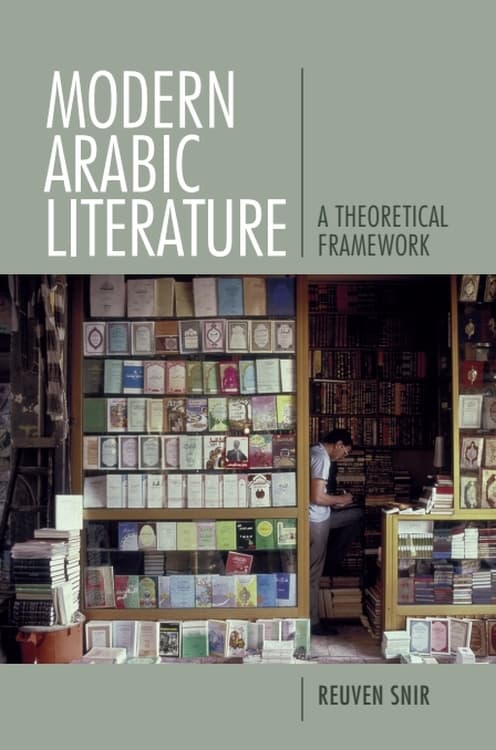
Modern Arabic Literature
A Theoretical Framework

Our ebooks are read in the Academic Reader app. After you buy, we’ll email you how to open your ebook in it.
Description
Outlines a theoretical operative framework for the study of modern Arabic literature
The study of Arabic literature is blossoming. This book provides a comprehensive theoretical framework to help research this highly prolific and diverse production of contemporary literary texts. Based on the achievements of historical poetics, in particular those of Russian formalism and its theoretical legacy, this framework offers flexible, transparent, and unbiased tools to understand the relevant contexts within the literary system. The aim is to enhance our understanding of Arabic literature, throw light on areas of literary production that traditionally have been neglected, and stimulate others to take up the fascinating challenge of mapping out and exploring them.
Key features- Includes inventories of both canonized and non-canonized literary texts in three sections: texts for adults, texts for children, and translated texts for adults and children
- Looks at the historical diachronic interaction of literature with various extra-literary systems such as religion, territory, state nationalism, language, politics, economy and gender as well as foreign literatures and cultures
- Focuses on the study of each genre together with examining the relationships between the various genres and the role of translation in their development
- Highlights the concept of periodization, looking at how to delimit and define literary periods
- Conceptualizes sociocultural distinctions of text production in terms of literary stratification, avoiding evaluative judgments
Contents
PrefaceTransliterationIntroduction
Chapter One: The Modern Arabic Literary System1. The Scope of the Research Subject2. Popular Literature and Legitimation3. Assumptions behind the Operative Model
Chapter Two: Literary Dynamics in Synchronic Cross-Section1. Canonical Literature1.a. Texts for Adults1.b. Texts for Children1.c. Translated Texts2. Non-Canonical Literature2.a. Texts for Adults2.b. Texts for Children2.c. Translated Texts3. Internal and External Interrelationships
Chapter Three: Outlines of Diachronic Intersystemic Development1. Literature / Religion2. Literature / Territory3. Literature / Language4. Literature / State Nationalism
Chapter Four: Literary Dynamics in Generic and Diachronic Cross-Section1. Periodization2. Classical vis-à-vis Modern Literature3. The Development of the Genres3.a. Poetry3.b. Fiction3.c. Theater4. Generic Interrelationships
ConclusionReferencesIndex
Author
Reviews
‘Reuven Snir provides his readers with a wealth of theoretical and applied information that takes in the entire modern tradition of Arabic literary creativity. It is an amazing achievement, well-arranged and comprehensively documented . . . The study demonstrates an enviable knowledge of the relevant theoretical and critical literature in both Western and Arab-world sources . . . I know of no work currently available that aspires to take on a subject this broad, and that does so with such conspicuous success and insight.’
Goes well with this book
From the same series or subject.
- Modern Arabic Literature, Ebook (EPUB), £33.99
- Biography of an Ottoman Provincial Town, Ebook (EPUB), £85.00
- Demographic Anxiety in Turkey, Ebook (EPUB), £90.00
More in IMES
View allEbook (EPUB)£90.00
Ebook (EPUB)£14.99
Ebook (EPUB)£100.00
Ebook (EPUB)£95.00