Ebook (EPUB)£90.00
LawEncounters in Law & Philosophy
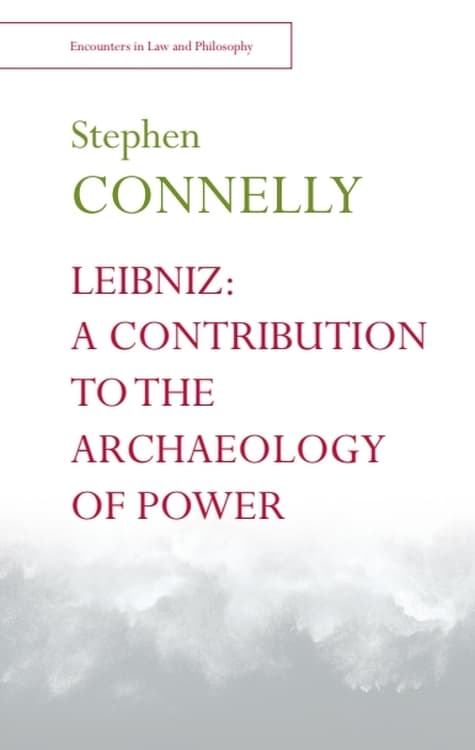
Leibniz: A Contribution to the Archaeology of Power

Our ebooks are read in the Academic Reader app. After you buy, we’ll email you how to open your ebook in it.
Description
A critical reading of Leibniz’s legal theory, linking law, space and power
- Critically links Leibniz to legal theory and situates him with respect to thinkers such as Spinoza, Hobbes, Husserl, Deleuze, Foucault and Badiou
- Builds on the French archaeology of power research programme of Agamben collaborator Gwenaëlle Aubry
- Excavates a theory of law and space
- Provides an account of key tenets of medieval philosophy, such as power, reality, subjective activity, being-in-common, that inform the thought of continental philosophers
The concept of power has been a major feature of natural law theories. It evolved over the course of several centuries and was arguably the defining notion in both Hobbes’ and Spinoza’s doctrines of natural right. Yet Leibniz appears to effect a reversal in this millennium-long trajectory and demotes power to a derivative term of his philosophy.
What was the rationale behind this radical change? And what does this reversal mean for the philosophy that follows?
Connelly demonstrates how Leibniz’s rearticulation of power and its associated concepts is motivated at least in part by the struggles that marked the terrain in which his ideas were rooted – the struggle between Reformed and Scholastic theology, between natural law and natural right, and between mechanistic natural philosophy and human freedom. He locates Leibniz within power’s wider evolution, and shows how the universal jurisprudence which Leibniz developed between the 1660s and 1690s can be considered as a transformative encounter between power, activity and modality.
Drawing on thinkers as diverse as Aristotle, Aquinas, Duns Scotus, Grotius, Husserl and Deleuze, Connelly traces Leibniz’s conceptualisation of power through its applications in his legal texts, revealing that Leibniz in fact reconceptualises power under a new name: the state space. The move amounts to an internalisation of power as a moral world within each individual, submitting each practical agent to a universal set of obligations and prohibitions defined by that world. What though is at stake in bringing the objective world within each individual and submitting it to a public legal order? And what is the significance of this surgical intervention for any archaeology of power?
Contents
AcknowledgementsIntroduction
1. From Trinity to Mind: The Intensional Basis of the Law 2. Potency and Supposita 3. Will: The Scholastic heritage 4. Will, power, and pretensionality 5. Ars combinatoria as Urdoxa 6. A New Method of Teaching Law 7. Power and obligation in the 1660s 8. Power and obligation in the Elementa Iuris Naturalis: the state space
Conclusion Bibliography Index
Author
Reviews
Connelly has crafted an intricate and illuminating analysis of Leibniz’ thought that both challenges and enriches our understanding of the philosophy of power. This work is invaluable to scholars of law and philosophy, and makes an important contribution to the history of ideas.
[Connelly] demonstrates how the Leibnizian theory of will and potentia presupposes the concept of primary matter, which, when applied to a jurisprudential perspective, is identified by Connelly as a ‘state place’, which allows us to understand the role of universal obligation and prohibition in Leibniz’s philosophy and their divergence from the rights of individuals. Uncovering, in an ‘archaeological’ manner, and explicating this notion can be regarded as actually the most substantial and original element of the reviewed book [...] the book under review is the result of a highly developed, diligent and revealing study of the Leibnizian philosophy and it will certainly provide inspiration for many researchers.
[Connelly] demonstrates how the Leibnizian theory of will and potentia presupposes the concept of primary matter, which, when applied to a jurisprudential perspective, is identified by Connelly as a ‘state place’, which allows us to understand the role of universal obligation and prohibition in Leibniz’s philosophy and their divergence from the rights of individuals. Uncovering, in an ‘archaeological’ manner, and explicating this notion can be regarded as actually the most substantial and original element of the reviewed book. […] the book under review is the result of a highly developed, diligent and revealing study of the Leibnizian philosophy and it will certainly provide inspiration for many researchers.
Goes well with this book
From the same series or subject.
- Leibniz: A Contribution to the Archaeology of Power, Ebook (EPUB), £27.99
- Towards a Genealogy of Cosmopolitan Thought, Ebook (EPUB), £90.00
- The Anarchist before the Law, Ebook (EPUB), £24.99
From the same series
More in Encounters in Law & Philosophy
Ebook (EPUB)£24.99
Ebook (EPUB)£20.99
Ebook (EPUB)£26.99
Ebook (EPUB)£37.00
Ebook (EPUB)£31.00
Ebook (EPUB)£25.99