Ebook (EPUB)£19.99
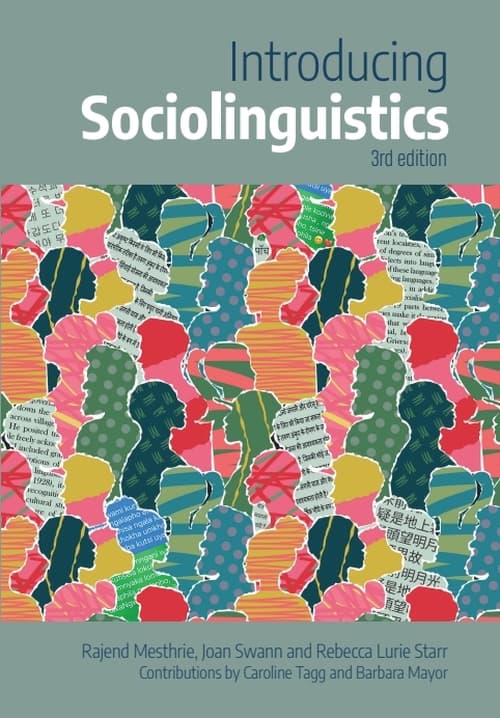
Introducing Sociolinguistics

Our ebooks are read in the Academic Reader app. After you buy, we’ll email you how to open your ebook in it.
Description
Provides a solid foundation in all aspects of sociolinguistics
- Accessibly written with the beginner in mind
- 12 fully revised chapters, including 2 entirely new chapters: Modes, Media, Mobilities; Globalisation and Language
- A glossary and over 100 maps, diagrams, inset boxes, drawings and cartoons clearly demonstrate key concepts, data and ideas
- An international focus supported by numerous examples from multilingual settings
- New topics covered include globalisation, migration, the sociolinguistics of writing, new modes of communication and youth languages
Written by teachers with first-hand experience of sociolinguistic developments on four continents, this textbook has introduced thousands of students worldwide to the central topics in sociolinguistics. Now fully updated to reflect the new debates, approaches, and findings within the field, this is the perfect resource for those taking introductory courses in Sociolinguistics, Language and Society, Identity and Power and Language Variation and Change.
The book covers multilingualism, code-choice, language variation, dialectology, interactional studies, gender, language contact, language and inequality, and language and power. Brand new additions include: an innovative new chapter exploring globalisation and language, a new chapter on writing and multimodality and new sections exploring areas such as migration, gender and identity, the sociolinguistics of writing, new modes of communication and youth languages.
Contents
List of Tables, Maps and Figures
Abbreviations
Acknowledgements
Phonetic Note to Readers
1. Clearing the Ground: Basic Issues, Concepts and Approaches
Rajend Mesthrie
- 1.1 Introduction
- 1.2 Relations between Language and Society
- 1.3 Prescriptivism
- 1.4 Standardisation
- 1.5 Speech, Sign, Writing and Digital Communication
- 1.6 Societies and Communities
- 1.7 Monolingualism and Multilingualism
- 1.8 Conclusion
- Notes
2. Regional Dialectology
Rajend Mesthrie
- 2.1 Introduction
- 2.2 A Multilingual Project: The Linguistic Survey of India
- 2.3 Monolingual Dialectology in Europe
- 2.4 Modern Approaches to Dialect
- 2.5 Other Facets of Dialect Variation
- 2.6 Conclusion
- Notes
3. Social Dialectology
Rajend Mesthrie
- 3.1 Introduction
- 3.2 Principles and Methods in Variationist Sociolinguistics
- 3.3 Fieldwork Methods in Variationist Sociolinguistics
- 3.4 More on Social Categories and Language
- 3.5 Sociolinguistics on Trial: An Application of Urban Dialectology
- 3.6 Conclusion
- Notes
4. Language Variation and Change
Rebecca Lurie Starr
- 4.1 Introduction
- 4.2 The Relationship between Variation and Change
- 4.3 Patterns of Change
- 4.4 Approaches to Studying Change
- 4.5 Social Factors and Language Change
- 4.6 Social Networks and Language Change
- 4.7 Other Factors in Change
- 4.8 Conclusion
5. Style and Stylistic Variation
Rebecca Lurie Starr
- 5.1 Introduction
- 5.2 Style, Register and Enregisterment
- 5.3 Attention Paid to Speech
- 5.4 Audience-Focused Approaches
- 5.5 The Third Wave Tradition and the Speaker-Focused Approach
- 5.6 Style and Social Groups: Communities of Practice
- 5.7 Stylisation and Language Crossing
- 5.8 Conclusion
6. Language Choice and Code-switching
Rajend Mesthrie and Joan Swann, with contributions by Barbara Mayor
- 6.1 Introduction
- 6.2 Language Choice in Multilingual Communities
- 6.3 Code-switching in Multilingual Communities
- 6.4 Code-switching and Script Play
- 6.5 Multilingual Ecologies: The Study of Linguistics Landscapes
- 6.6 From Code-switching to (Trans)Languaging
- 6.7 Conclusion
- Notes
7. Language in Interaction
Joan Swann
- 7.1 Introduction
- 7.2 The Organisation of Everyday Conversation
- 7.3 Narrative and Voice
- 7.4 Long Conversations and Text Trajectories
- 7.5 Conclusion
- Notes
8. Media, Modes, Mobilities
Caroline Tagg
- 8.1 Introduction
- 8.2 Media
- 8.3 Modes
- 8.4 Mobilities
- 8.5 Conclusion
- Notes
9. Gender and Language Use
Joan Swann
- 9.1 Introduction
- 9.2 Women's and Men's Language
- 9.3 Language Variation and Change
- 9.4 Gender in Interaction
- 9.5 Contextualised Approaches: Performance and Performativity
- 9.6 Reconceptualisations: Intersectionality Bodies, Modes and Media, and the Global South
- 9.7 Conclusion
- Notes
10. Language Contact and its Outcomes
Rajend Mesthrie
- 10.1 Introduction
- 10.2 Contact, Borrowing and Lexical Creativity
- 10.3 Language Maintenance, Shift, Decline and Revival
- 10.4 Revitalising Endangered Languages
- 10.5 Pidgin and Creole Formation
- 10.6 Bilingual Mixed Languages
- 10.7 Conclusion
- Notes
11. Globalisation and Language
Rebecca Lurie Starr
- 11.1 Introduction
- 11.2 Phenomena Associated with Globalisation
- 11.3 Globalisation, Media and Language Change
- 11.4 World Languages, World Englishes
- 11.5 Globalisation, Language and Tourism
- 11.6 Globalisation, Language and Music
- 11.7 Conclusion
12. Language and Power
Rajend Mesthrie
- 12.1 Introduction
- 12.2 Power
- 12.3 Critical Discourse Analysis
- 12.4 Critical Language Awareness in Action
- 12.5 Resistance to Powerful Language
- 12.6 Language and Symbolic Power
- 12.7 Coloniality and Decoloniality
- 12.8 Conclusion
- Note
Bibliography
Glossary
Index
Authors
Reviews
The international team behind this new edition draws deeply on global scholarship. The book delivers exceptional technical and theoretical training with vivid and diverse data. It reflects the true breadth of the field — spanning classic and new media, cultures, and insights in a fast-changing world.
Goes well with this book
From the same series or subject.
- Introducing Sociolinguistics, Ebook (EPUB), £29.95
- An Introduction to the English Writing System, Ebook (EPUB), £19.99

- Geolingual Studies on Urban Space, Ebook (EPUB), £125.00
More in Language & Linguistics
View allEbook (EPUB)£125.00
Ebook (EPUB)£105.00

Ebook (EPUB)£95.00

Ebook (EPUB)£90.00