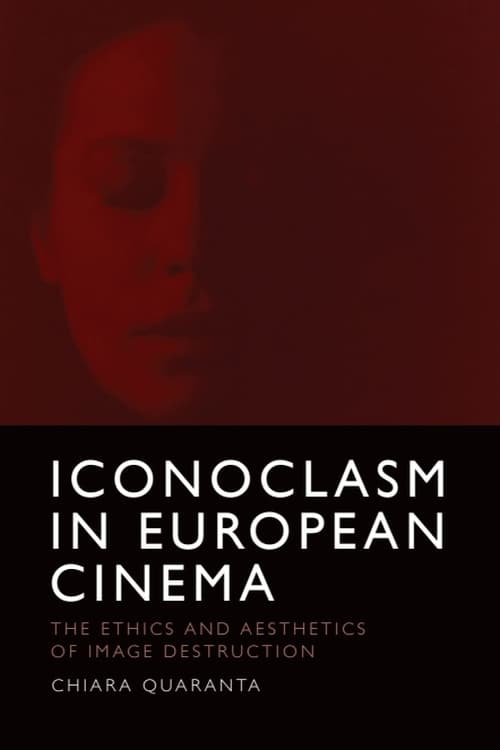
Iconoclasm in European Cinema
The Ethics and Aesthetics of Image Destruction
Open access under CC-BY-NC-ND 4.0
Description
The first full-length study on iconoclasm and cinema, bringing together ancient philosophy, medieval theology and contemporary film and image theory
- Offers a new, interdisciplinary approach to film ethics by looking at anti-mimetic images and sounds
- Investigates the relationship between a disruptive aesthetics and its ethical potential, establishing a dialogue between the philosophical distrust in visual images and the breaking of mimesis in cinema
- Explores the dichotomy between two types of images fundamental for philosophical and Christian iconoclasm – the eikōn and eidōlon –, tracing a thread from Plato’s philosophy up to contemporary films
Exploring anti-mimesis and image destruction in Western European films, Iconoclasm in European Cinema: The Ethics and Aesthetics of Image Destruction offers the first comprehensive study of philosophical iconoclasm in the cinema. Drawing on continental philosophy of the image, medieval theology and recent developments in film ethics, it investigates the aesthetic and ethical significance of destroying certain film images, both literally (via damages to the filmstrip) and metaphorically (through blank screens, altered motion and disruptive sounds). Analysing the work of various filmmakers, the book considers iconoclastic gestures against the film image’s ability to mimetically represent contents on the verge of the invisible and the ineffable.
This book demonstrates that the overlooked issue of iconoclasm in film is essential for understanding contemporary attitudes towards images and argues that cinematic iconoclasm can encourage an ethics of (in)visibility by questioning the limits of our right to see and show something on a screen.
Contents
Figures
Acknowledgements
Introduction
Prologue: The Eikōn-Eidōlon Dichotomy from Plato to Film
Part I. Cinematic Iconoclasm as Critique: The Image as Eidōlon
Chapter 1. Aural Cinema: Isidore Isou’s Traité de bave et d’éternité
Chapter 2. An Aesthetics of Displeasure: Guy Debord’s Destructive Oeuvre
Chapter 3. Towards a Radical Voice: Carmelo Bene’s Our Lady of the Turks
Chapter 4. In Search of a True Image: Jean-Luc Godard’s Histoire(s) du cinéma
Part II. Cinematic Iconoclasm as an Ethics of (In)visibility: The Eikōn as Iconoclastic
Chapter 5. Impossible Encounters: Marguerite Duras’s Le Navire Night
Chapter 6. Blind Vision, Aural Resonances: Derek Jarman’s Blue
Chapter 7. Crumbling Faces: Ingmar Bergman’s Cries and Whispers
Chapter 8. Blocks of Suffering: Krzysztof Kieślowski’s Three Colours: Blue
Conclusion: A Communal Vision through Broken Images
Notes
Glossary
Bibliography
Filmography
Author
Reviews
Brimming with sharp insights and concise observations, Chiara Quaranta’s scintillating and exquisitely interdisciplinary study engages with a broad range of canonical works of art cinema and the avant-garde to analyze how the destruction of images can be a productive practice both artistically and ethically.
Through detailed and engaging readings of select films—by Bene, Bergman, Debord, Duras, Godard, Isou, Jarman, and Kieślowski—Chiara Quaranta demonstrates impressively how the destruction of the image within European cinema can be generative of an enabling ethics which foregrounds the importance of listening and imagining in the film experience.
Iconoclasm in European Cinema is an extremely useful guide for thinking about the nature of moving images as processual apparatuses, never constricted or reduced to their apparent representational function,
but rather to be intended as experiential and dialogical means of signification.
Goes well with this book
From the same series or subject.

More in Film Studies
View all
Ebook (EPUB)£90.00
Ebook (PDF)£19.99
Ebook (EPUB)£95.00
£24.99