
Ebook (EPUB)£85.00
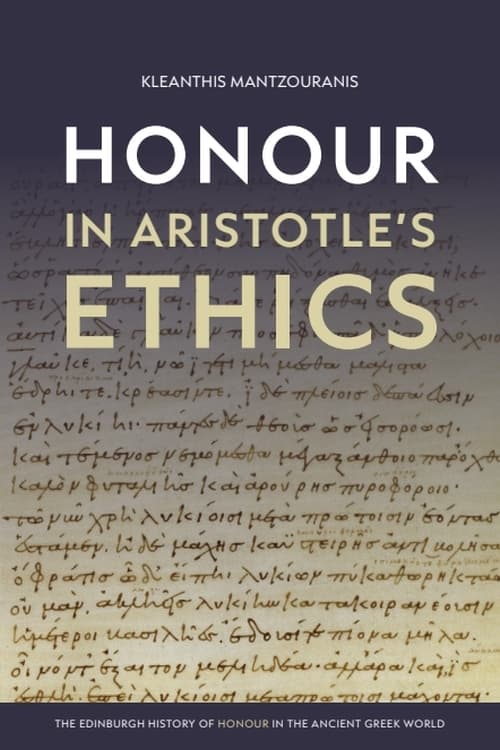
Ancient History & Classical StudiesThe Edinburgh History of Honour in the Ancient Greek World
Honour in Aristotle's Ethics
Open access
Open access under CC-BY-NC-ND 4.0
Description
Why does Aristotle label honour (timē) as the ‘greatest’ among the external goods required for the good life (eudaimonia)? And how does this statement relate with human emotions and Aristotle’s famous assertion that human beings are by nature political animals? Despite the dominant place of honour in Aristotle’s philosophy of human affairs (ethics, politics, rhetoric), its role has been grossly understudied, mainly because honour has been erroneously conceived as an outmoded notion out of sync with modern preoccupations and concerns. Drawing on contemporary sociology, philosophy and psychology, this monograph offers a thorough re-evaluation of Aristotelian timē that challenges common assumptions both about ancient and about modern ‘honour’. Aristotle’s incisive remarks on the role of timē in human psychology and behaviour reveal that, far from being a parochial concept, Greek timē is indicative of a universal human concern for esteem and social recognition in our lives as social beings.
Contents
Acknowledgments
Abbreviations, Editions, Transliteration
Introduction
1. The Features of Honour
2. Honour, Axia and Self-Respect: Emotions Towards Face-Threats
3. Honour, Axia and the Principles of Social Interaction: Emotions and Virtues of Sociability
4. Emotions Towards the Fortunes of Others: Pity and Indignation
5. Emotions of Social Comparison: Envy and Emulation
6. ‘Proper Love of Honour’ or Philotimia
7. Greatness of Soul
Conclusion
Bibliography
Author
Reviews
...a thorough and insightful survey of the topic in the Aristotelian corpus and Greek literature broadly. [...] Mantzouranis does a masterful job compiling Aristotle’s scattered remarks on honor across several texts and shaping them into a coherent viewpoint.
This excellent and systematic book combines philosophical analysis and scholarly accuracy to vastly improve our understanding of honour and respect – a central but unduly neglected topic in Aristotle’s ethics. Mandatory reading for all students of Aristotle’s ethics – especially for philosophers struggling to see how Aristotle relates to modern ethics.
Goes well with this book
From the same series or subject.
More in Ancient History & Classical Studies
View allEbook (EPUB)£100.00
Ebook (EPUB)£95.00

Ebook (EPUB)£95.00
Ebook (EPUB)£135.00