Ebook (EPUB)£19.99
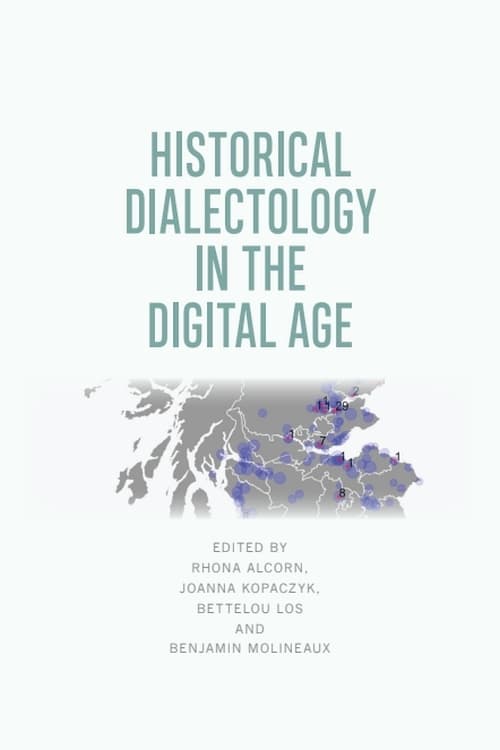
Historical Dialectology in the Digital Age

Our ebooks are read in the Academic Reader app. After you buy, we’ll email you how to open your ebook in it.
Description
A survey of applications of digital methods and tools to explore the linguistic features of regional varieties in historical texts
Drawing on the resources created by the Institute of Historical Dialectology at the University of Edinburgh (now the Angus McIntosh Centre for Historical Linguistics), such as eLALME (the electronic version A Linguistic Atlas of Late Medieval English), LAEME (A Linguistic Atlas of Early Middle English) and LAOS (A Linguistic Atlas of Older Scots), this volume illustrates how traditional methods of historical dialectology can benefit from new methods of data-collection to test out theoretical and empirical claims. In showcasing the results that these resources can yield in the digital age, the book highlights novel methods for presenting, mapping and analysing the quantitative data of historical dialects, and sets the research agenda for future work in this field.
Bringing together a range of distinguished researchers, the book sets out the key corpus-building strategies for working with regional manuscript data at different levels of linguistic analysis including syntax, morphology, phonetics and phonology. The chapters also show the ways in which the geographical spread of phonological, morphological and lexical features of a language can be used to improve our assessment of the geographical provenance of historical texts.
- Lays out key corpus-building strategies for working with regional data at different levels of linguistic analysis: syntax, lexicon, morphology, and phonetics/phonology
- Shows how traditional methods of Historical Dialectology can benefit from new methods of data-collection to test out theoretical and empirical claims
- Highlights opportunities and pitfalls for analysing the relation between sound systems and spellings
Contents
Contents
List of Figures and Tables
Notes on Editors
Notes on Contributors
Preface
Acknowledgements
1 Historical Dialectology and the Angus McIntosh Legacy
Rhona Alcorn, Joanna Kopaczyk, Bettelou Los and Benjamin Molineaux
Part 1 Creating and Mining Digital Resources
2 A Parsed Linguistic Atlas of Early Middle English
Robert Truswell, Rhona Alcorn, James Donaldson and Joel Wallenberg
3 Approaching Transition Scots from a Micro-perspective; The Dunfermline Corpus, 1573–1723
Klaus Hofmann
4 Early Spelling Evidence for Scots L-vocalisation: A Corpus-based Approach
Benjamin Molineaux, Joanna Kopaczyk, Warren Maguire, Rhona Alcorn, Vasilis Karaiskos and Bettelou Los
Part 2 Segmental Histories
5 Old and Middle English Spellings for OE hw-, with Special Reference to the ‘qu-’ Type: In Celebration of LAEME, (e)LALME, LAOS and CoNE
Margaret Laing and Roger Lass
6 The Development of Old English ǣ: The Middle English Spelling Evidence
Gjertrud F. Stenbrenden
7 The Development of Old English eo/ēo and the Systematicity of Middle English Spelling
Merja Stenroos
8 Examining the Evidence for Phonemic Affricates: Middle English /t͡ʃ/, /d͡ʒ/ or [t-ʃ], [d-ʒ]?
Donka Minkova
Part 3 Placing Features in Context
9 The Predictability of {S} Abbreviation in Older Scots Manuscripts According to Stem-final Littera
Daisy Smith
10 An East Anglian Poem in a London Manuscript? The Date and Dialect of The Court of Love in Cambridge, Trinity College, MS R.3.19
Ad Putter
11 ‘He was a good hammer, was he’: Gender as Marker for South-Western Dialects of English. A Corpus-based Study from a Diachronic Perspective
Trinidad Guzmán-González
Index
Authors
Reviews
The present volume is a very valuable contribution to the field of English historical dialectology. It demonstrates that the door for the linguistic analysis of early and late medieval texts and their language has been opened anew. It shows that there is an opportunity for more nuanced questions and more precise insights through the options presented by digitised corpora and/or digital methods (as complements to traditional, analogue corpora and methods). The overarching question – namely how digital methods can be used to investigate diachronic variation and language change – is addressed at different linguistic levels. It is the interplay between spelling variation and pronunciation which comes to the fore, as it is at the heart of half of the contributions (chapters 4, 5, 6, 7, 8), but syntactic variation and change, as well as morphological and lexical variation, do also find their places. The individual chapters all present their data and analyses with clarity and conciseness...All in all, the volume is a very good collection of papers, and it will be a handy and useful resource for students and more experienced scholars interested in the state of the field and what one can do with digitised corpora and digital methods.
The chapters in this volume provide a fascinating insight into the state of the art of historical dialectology, and, in the span of age and experience represented by the authors, ranging from Emeritus professors to doctoral candidates, reassure us that the future of this discipline and the legacy of Angus McIntosh are in safe hands... Historical Dialectology in the Digital Age thus gives the reader a greater understanding of the past and an intriguing glimpse into the future of historical dialectology. It will be of interest not only to historical linguists, but to those working with linguistic corpora of all kinds.
Overall, Alcorn, Kopaczyk, Los, and Molineaux have brought together a great collection of papers that function as an excellent introductory work to the tools and methods available to the historical dialectologist working in the digital age. This volume both shows the value that digital methods hold for the study of historical linguistics and simultaneously underlines the need for new tools to continue to be developed. With its varied collection of contributions and contributors, this volume will appeal to both advanced scholars in the field of historical linguistics who are interested in keeping up with recent developments in the field, as well as to those wishing to acquaint themselves with the various tools and methods that are available. In short, HDDA is a valuable contribution to the field of historical dialectology and will hopefully serve to introduce its readers both to the true and tried methods of digital linguistic research as well as to new and exciting possibilities.
Historical Dialectology in the Digital Age illustrates how historical dialectology has profited from the field’s speedy willingness to embrace and develop new digital technologies, and much of that initiative has come from the Angus McIntosh Centre for Historical Linguistics. Despite its focus on English and Scots, researchers working on the historical dialectology of other languages will benefit greatly from reading this volume.
This volume brings historical dialectology fully into the digital world. Not only do we learn about aspects of Medieval and Early modern varieties of English and Scots, but also the latest methods in corpus construction, tagging/annotation and analysis — making it essential reading for a wide array of historical linguists. With breadth yet no loss of coherence or depth, this volume can assure us that Angus McIntosh’s legacy is in good hands.
Goes well with this book
From the same series or subject.
- Historical Dialectology in the Digital Age, Ebook (EPUB), £27.99
- An Introduction to the English Writing System, Ebook (EPUB), £19.99
- Geolingual Studies on Urban Space, Ebook (EPUB), £125.00
More in Language & Linguistics
View allEbook (EPUB)£125.00
Ebook (EPUB)£105.00
Ebook (EPUB)£95.00
Ebook (EPUB)£90.00