Ebook (EPUB)£125.00
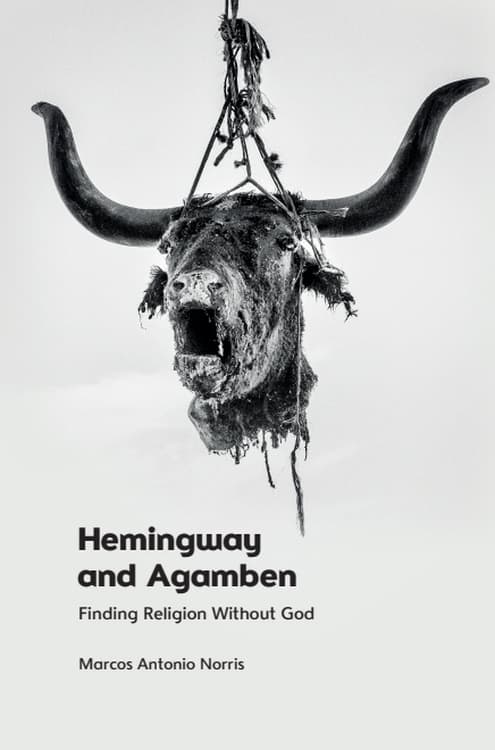
Hemingway and Agamben
Finding Religion Without God

Our ebooks are read in the Academic Reader app. After you buy, we’ll email you how to open your ebook in it.
Description
Interprets Hemingway’s fiction through the philosophical lens of Giorgio Agamben
- Resolves debate over Hemingway’s religious orientation
- Brings Hemingway, Jean-Paul Sartre, and Giorgio Agamben into close conversation for an interdisciplinary study of political theology, existentialism, posthumanism, and modernist literature
- Leverages Giorgio Agamben’s analysis of secularization for an unprecedented reading of Hemingway’s fiction
- Reveals the Roman Catholic foundations of secular existentialism, as well as the existential underbelly of literary modernism
- Presents the ritualistic killing of animals by human beings as the latter’s semi-conscious attempt to reclaim the imago Dei
- Builds upon the preceding points to level a posthumanist critique of moral absolutism
Marcos Antonio Norris implements Giorgio Agamben’s notion of ‘secularized theism’ to resolve a critical disagreement among Hemingway scholars who have portrayed the writer as either a Roman Catholic or a secular existentialist. He argues that Hemingway is, properly speaking, neither a secularist nor a theist, but a ‘secularised theist’, whose ‘religion’ is practiced through sovereign decision making, which, in its most extreme form, includes the act of killing. This book resolves an important debate in Hemingway studies and uncovers fundamental similarities between theism and atheism, building upon the theoretical undertaking first introduced by Agamben and the Existentialists (EUP, 2021). Bringing Ernest Hemingway, Jean-Paul Sartre and Giorgio Agamben into close conversation, the author reconceptualises existentialism, issues a posthumanist critique of moral authoritarianism and advances an original interpretation of Hemingway as a secularised theist.
Contents
PART I: HEMINGWAY, SARTRE, AND THE SECULAR
An Introduction
A Word on Secularization
Hemingway as Religious Believer
Sartre as Religious Believer
Returning to Hemingway
Book Summary
PART II: SOVEREIGN DECISIONISM AND THE IMAGO DEI
The Failed Atheism of Jean-Paul Sartre
The Biographical Origins of Sartre’s Failed Atheism
Agamben and the Creation of Mankind
Looking at Sartre Through Agamben’s Eyes
Hemingway’s Youth as an Oak Park Congregationalist
A Change in Hemingway’s Religious Temperament
Hemingway the Existentialist
Hemingway the Catholic
Hemingway the Un/Believer
PART III: THE PROBLEM WITH HUMAN EXCEPTIONALISM
Approaching the Masculine in Hemingway’s Fiction
On the Quai at Smyrna
Death in the Afternoon
Hemingway’s Stance on Animal Equality
PART IV: HEMINGWAY’S MASCULINE HERO
There Are No Happy Endings
On the Use of Ritual
Suicide as Cowardice
The Faena, Or Becoming Like God
The Masculine, Existential Hero
Cause for Question in Hemingway’s Posthumous Works
Conclusion: The Death of God, The Death of Man
BIBLIOGRAPHY
INDEX
Author
Reviews
Norris uses Agamben to offer a very welcome and original response to a long-standing critical impasse. Smart, insightful, and persuasive, this study ranges widely across Hemingway’s work and has important implications for how we understand Hemingway’s treatment of religion, the sovereign individual, gender, morality, and the human/animal divide.
Goes well with this book
From the same series or subject.
- Hemingway and Agamben, Ebook (EPUB), £24.99
- Narrative of the Life of Sir Walter Scott, Bart., Volume II, Ebook (EPUB), £125.00
- Intermedial Authorship, Ebook (EPUB), £110.00

More in Literary Studies
View allEbook (EPUB)£110.00

Ebook (EPUB)£90.00
Ebook (EPUB)£90.00
Ebook (EPUB)£90.00