Ebook (EPUB)£90.00
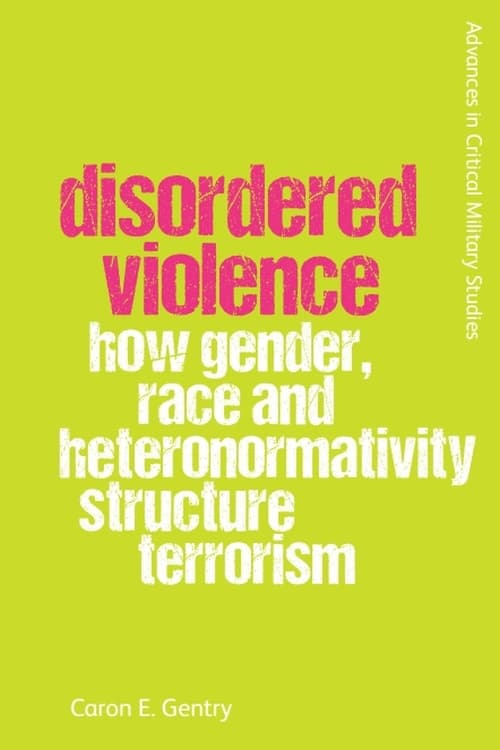
PoliticsAdvances in Critical Military Studies
Disordered Violence
How Gender, Race and Heteronormativity Structure Terrorism

Our ebooks are read in the Academic Reader app. After you buy, we’ll email you how to open your ebook in it.
Description
A feminist interrogation of how terrorism is constructed as a violence that upsets the order of international politics
- Strongly critiques ‘radicalisation’ by looking at UK Prevent and Prevent Tragedies
- Conducts 8 profiles of various terrorist actors, including Andreas Baader, Bernardine Dohrn, Leila Khaled, Dhanu, Anders Breivik, Nidal Hasan and Aafia Siddiqui
- Discusses the mass shooters Elliot Rodger, Dylann Roof and Anders Breivik in relation to misogynistic terrorism
- Provides an intersectional feminist critique of terrorism studies
Disordered Violence looks at how gender, race, and heteronormative expectations of public life shape Western understandings of terrorism as irrational, immoral and illegitimate. Caron Gentry examines the profiles of 8 well-known terrorist actors. Gentry looks for gendered, racial, and sexualised assumptions in how their stories are told. Additionally, she interrogates how the current counterterrorism focus upon radicalisation is another way of constructing terrorists outside of the Western ideal. Finally, the book argues that mainstream Terrorism Studies must contend with the growing misogynist and racialised violence against women.
Contents
Introduction: Welcome to the Grey
- The Structural Signification of Terrorism
- Intersecting Terrorism Studies
- Strange Bedfellows: What Happens When We Ask the Other Question?
- Ir/rationality: Radicalisation, ‘Black Extremism,’ and Prevent Tragedies
- What Does Not Get Counted: Misogynistic Terrorism
Conclusion: Disordered Violence
Notes
Author
Reviews
In this book, Gentry sheds some light on how and why terrorism is problematic in international politics. The disorder of terrorism challenges the dominant system and this violence needs to be seen as irrational, illegitimate and immoral. Gentry’s reflection is therefore crucial to rethink Terrorism Studies and, above all, Critical Terrorism Studies [CTS] …Her intersectional feminist analysis will thus help CTS not only to deconstruct hegemonic discourses of (counter-)terrorism but understand how and why certain violence is accepted – and even legitimated – while other kinds are not … Gentry’s reflection on the hegemonies constituting the international order is a timely and enriching contribution to CTS, one that needs to be put at the core of critical understandings of terrorism aimed at shedding light on the dimensions of power structuring political violence.
A timely contribution that deepens our understanding of the racialised, gendered, and sexualised structure of (academic) debates on, and representations of, terrorism and violence. The book outlines how race, sexuality, and gender are implicated in security discourses and shows why security studies must take an intersectional, feminist, queer, and critical race analytic seriously. … It serves as a provocation for scholars to do better and more intersectional work that attends to the racialised-sexualised-gendered foundations of international relations; both small and large caps. It is a lesson in how to do outstanding intersectional feminist work that should be emulated. Disordered Violence reiterates how it is no longer acceptable to say ‘I am not asking the gender (or race, or sexuality) question’ when these are baked into (the study of) international politics.
Once again pushing at the boundaries of military, security and feminist security studies, Gentry’s analysis exposes the ‘wilful forgettings’ of race, gender and sexuality that underpin the so-called ‘War on Terror’. Exposing the ways in which violence is ordered in global politics, she demands an intersectional awakening from a collective aphasia in both scholarship and practice of global security politics that sustain a hierarchy of insecurities.
In this thoughtful meditation on power and knowledge, Caron Gentry shows us how constructions of terrorists and terrorism in Terrorism Studies and IR underpin dominant motifs of the international order and its states system. Knowledge practices not only reflect but reproduce international hierarchy and its characteristic forms of domination. She accomplishes this through a novel and revealing intersectional analysis of those constructed as terrorists. Gentry is one of the few scholars willing to confront just how deeply the academic discipline of IR is embedded in the power structures it purports to study.
Goes well with this book
From the same series or subject.
- Disordered Violence, Ebook (EPUB), £22.99
- Pleasure and Depletion in Contemporary Militarism, Ebook (EPUB), £90.00
- The Militarisation of British Democracy, Paperback, £29.99
From the same series
More in Advances in Critical Military Studies
Paperback£29.99
Ebook (EPUB)£19.99
Ebook (EPUB)£24.99
Ebook (EPUB)£19.99
Ebook (EPUB)£19.99
Ebook (EPUB)£19.99

Ebook (EPUB)£25.99
Ebook (EPUB)£20.99
Ebook (EPUB)£20.99
Ebook (EPUB)£20.99
Ebook (EPUB)£27.99
More in Politics
View all
Ebook (EPUB)£25.00

Ebook (EPUB)£25.00
Ebook (EPUB)£16.99
Ebook (EPUB)£24.99