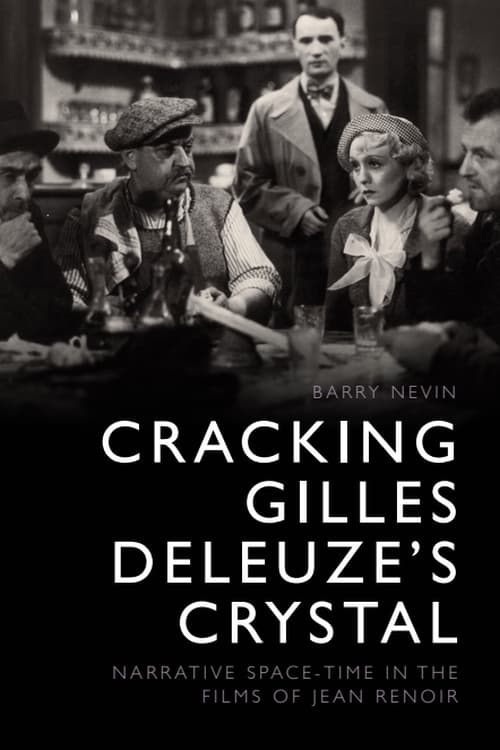
Cracking Gilles Deleuze’s Crystal
Narrative Space-time in the Films of Jean Renoir

Our ebooks are read in the Academic Reader app. After you buy, we’ll email you how to open your ebook in it.
Description
Jean Renoir is widely considered as one of the most important technical innovators and politically engaged filmmakers in cinema history. Reassessing the unique qualities of Renoir’s influential visual style by interpreting his films through Gilles Deleuze’s film philosophy, and through previously unpublished production files, Barry Nevin provides a fresh and accessible interdisciplinary perspective that illuminates both the consistency and diversity of Renoir’s oeuvre. Exploring canonised landmarks in Renoir’s career, including La Grande Illusion (1937) and La Règle du jeu (1939), the book also considers neglected films such as Le Bled (1929) and Diary of a Chambermaid (1946) to present a rounded analysis of this quintessential French auteur’s oeuvre.
Key Features- Examines the complex relationship between Deleuze’s film philosophy and spatial thought with clarity
- Clearly theorises key concepts including time and space
- Analyses films from each phase of Renoir’s career including his silent work, his politically engaged features of the 1930s, his Hollywood films and his post-war costume-dramas
- Investigates Renoir’s key settings, political engagement and evolutions in his narrative style
Contents
AcknowledgementsPreface
IntroductionTheorising Renoir’s narrative style: Bazin, Faulkner, and Braudy. The future beyond the point de fuite: opening the image-temps to spaceOpen spaces / open futures: filming spatial politics Reading Deleuze on Renoir: critical opinionsDiscursive positioning: Renoir auteur
Chapter 1 – Teatro Mundi: Framing Urban Dynamics in Renoir’s ParisIntroduction: Renoir, cinema and the cityLa Chienne (1931)Boudu sauvé des eaux (1932)La Règle du jeu (1939)Conclusion: Renoir’s Ville-concept
Chapter 2 – From Desert to Dreamscape: Viewing Renoir’s Rural Landscapes as Spatial ArenasIntroduction: opening the natural landscape to space-time Le Bled (1929)The Southerner (1945)The River (1951)Conclusion: dynamising the natural landscape
Chapter 3 – Portraying the Future(s) of the Front PopulaireIntroduction: theory and texts in contextLe Crime de Monsieur Lange (1936)Les Bas-fonds (1936)La Grande Illusion (1937)Conclusion: ‘We are dancing on a volcano’.
Chapter 4 – Renoir’s Crises Anti-réalistes: Framing le Temps GeléIntroduction: seeing time in the image planeDiary of a Chambermaid (1946)The Golden Coach (1952)Eléna et les hommes (1956)Conclusion: society and spectacle
ConclusionBibliography Appendix: Corpus Breakdown
Author
Reviews
Barry Nevin has written a compelling book that should inspire readers to (re)turn to Renoir. He fortifies his arguments with brand new research from the Renoir archives at UCLA, while also showing a wonderful interpretive eye. Indeed, his analysis of the periscope in Eléna et les hommes is just one of many moments that has changed the way I look at the film in question (p. 166). And if a work of film-philosophy can change the films it has made you watch, it is truly film-philosophy worthy of the name.
Scholarly, insightful, and respectful...Nevin demonstrates that much remains to be said about the great director. This subtle and detailed book will be welcomed by all those interested in Renoir’s films and in film philosophy more broadly.
Barry Nevin has here made a significant contribution to the densely-populated field of Renoir studies and the currently thriving world of Deleuzian film theory. The work is nourished by significant archival research and extensive interdisciplinary erudition. This is a book of great importance to all serious students of Renoir.
Goes well with this book
From the same series or subject.
- Cracking Gilles Deleuze’s Crystal, Ebook (EPUB), £25.99
- Adapting American Adulthood, Ebook (EPUB), £90.00
- Isabelle Adjani, Ebook (PDF), £19.99

More in Film Studies
View all
Ebook (EPUB)£90.00
Ebook (PDF)£19.99
Ebook (EPUB)£95.00
£24.99