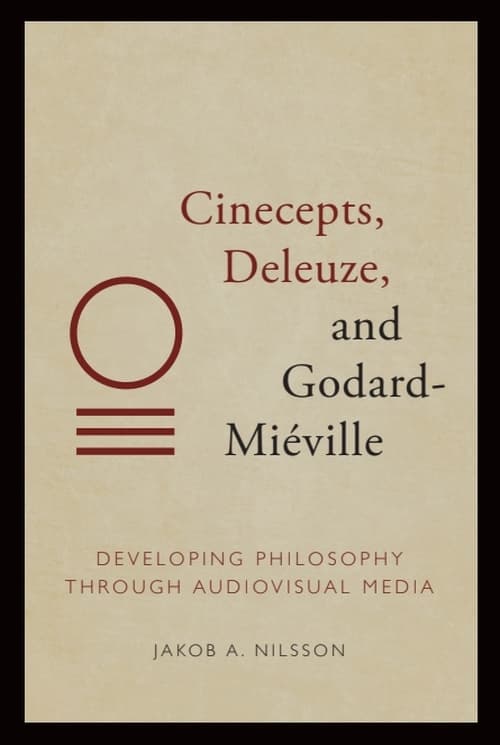
Cinecepts, Deleuze, and Godard-Miéville
Developing Philosophy through Audiovisual Media

Our ebooks are read in the Academic Reader app. After you buy, we’ll email you how to open your ebook in it.
Description
- Explores how concepts – original philosophical concepts – can be constructed as compounds of moving images/sounds/voice/texts/graphics/montage
- Builds on but also critically reexamines the work of Gilles Deleuze regarding the film/philosophy relation, concepts, and novelty
- Subjects Jean-Luc Godard and Anne-Marie Miéville’s 1970s video-works to extensive analysis, along with readings of two late-1960s Godard films and considerations of form in Histoire(s) du cinéma
- Critically explores debates and discourses on the ‘scholarly video essay’ and offers a cineceptual alternative
- Draws together Film-Philosophy, Philosophy, Deleuze studies, Godard Studies, Film Theory, Art Theory, Media Theory, Critical Theory, and Videographic Film Studies
As the spread of knowledge and even theory becomes an increasingly audiovisual affair, how can philosophy adapt in ways that develop – rather than dilute – philosophical rigor and specificity? How can philosophy harness the potential of audiovisual media – being more formally multidimensional than text-only – to conceptualize with greater precision and depth?
This book presents a theory of formal development of philosophy in this regard: a theory of cinecepts. While spanning film, media, art, and critical theories as well as philosophy, this study proceeds mainly through a close reimagination of the work of Gilles Deleuze, which allows for a merging of what he kept separated: filmic thinking and philosophical conceptualization. Jean-Luc Godard & Anne-Marie Miéville's underexplored 1970s Sonimage works are also the subject of extensive examination, along with critical considerations of a contemporary era of academic video essays and phenomena like philosophy channels on YouTube.
Contents
Acknowledgements
Preface
Introduction
Chapter 1. Towards a Theory of Cinecepts: A Reorganization of Deleuze’s Categories
Chapter 2. Setting the Stage: 2 or 3 Things, Le Gai Savoir, and Ici et Ailleurs
Chapter 3. The Problem of the New: Ideas, Cinema, Concepts
Chapter 4. Sonimage: A Problem Space and Six Embryonic Cinecepts
Chapter 5. Rapprochement, Concepts, and Cineceptual Form
Chapter 6. Scholarly Video Essays: A Critical Examination and A Cineceptual AlternativeChapter 7. Notes on Cinecepts as Multimedia Practice
Abbreviations of Works by Gilles Deleuze
References
Author
Reviews
Nilsson proposes both a new interpretation of the relationship between theory and practice in the work of Jean-Luc Godard and a new reading of Gilles Deleuze and the application of his thought to cinema. Nilsson delineates a rich new avenue for research in film-philosophy. No other book has examined in such detail or with such conviction Godard’s famous claim that cinema is ‘a form that thinks.’
This book closely examines the interconnections between cinema and philosophy; in line with, but also moving beyond Deleuze. The words "cinema" and "concepts" are here tightly bound up to shape a new theoretical development of audio-visual philosophy. It comes close to a specific version of what I have called "Image-Thinking".
This is a rewarding, engaging, and exciting book for anyone interested in Deleuzian cinematic philosophy and the role the video essay will inevitably play in scholarly debates moving forward.
Goes well with this book
From the same series or subject.
- Cinecepts, Deleuze, and Godard-Miéville, Ebook (EPUB), £19.99
- Adapting American Adulthood, Ebook (EPUB), £90.00

- Isabelle Adjani, Ebook (PDF), £19.99

More in Film Studies
View all
Ebook (EPUB)£90.00
Ebook (PDF)£19.99
Ebook (EPUB)£95.00
£24.99